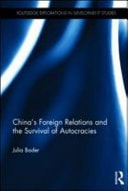
China's Foreign Relations and the Survival of Autocracies
0
0
As an Amazon Associate and affiliate partner, Menrva Books earns from qualifying purchases. Learn more
Author Description
This Book Investigates The Rise Of China As An Emerging Major Power And Seeks To Answer The Question Whether China's Rise Stabilises Other Non-democratic Leaders In The World. By Comparing China's Bilateral Relations To Three Asian Developing Countries - Cambodia, Burma And Mongolia - With Varying Political Types Of Regime, The Book Illustrates That The Chinese Government Has Indeed Profited From Exploiting Secretive Decision Making In Autocracies To Realise Its Own External Interests Such As Achieving Access To Natural Resources. However, Only Some Forms Of Bilateral Interaction, Such As High Trade Dependence On China, Effectively Do Increase The Prospect Of Survival For Autocratic Leaders While Others, Such As Diplomatic Relations Or Economic Cooperation Do Not Have Such An Effect-- Provided By Publisher.
Menrva's Summary
THE THESIS
This book investigates whether the rise of China as a major global power serves to stabilize autocratic regimes in developing nations. Author Julia Bader examines the mechanisms of Chinese foreign policy, utilizing a comparative framework to analyze how bilateral interactions influence the political longevity of non-democratic leaders. By synthesizing data from diverse political environments, the work argues that while certain economic dependencies bolster autocratic survival, other forms of diplomatic engagement do not yield the same stabilizing results.
THE SCOPE MAP
What You Will Find
- Comparative analysis of China's bilateral relations with Cambodia, Burma, and Mongolia.
- Examination of secretive decision-making processes within autocratic governance structures.
- Assessment of the impact of trade dependence versus diplomatic cooperation on regime stability.
- Investigation into the pursuit of natural resources as a primary driver of Chinese external interests.
THE AUTHORITY PERSPECTIVE
Experts identify this work as a significant contribution to the study of authoritarian resilience and international political economy. Readers frequently note the academic rigor and the clarity with which the author distinguishes between various types of bilateral interactions.
Page Count:
0
Publication Date:
2015-01-01
Publisher:
Routledge,
ISBN-10:
0415660955
ISBN-13:
9780203073827
China
Authoritarianism
Autocracy
Asian Studies
Foreign Policy
International relations
Community Tags
Similar Books