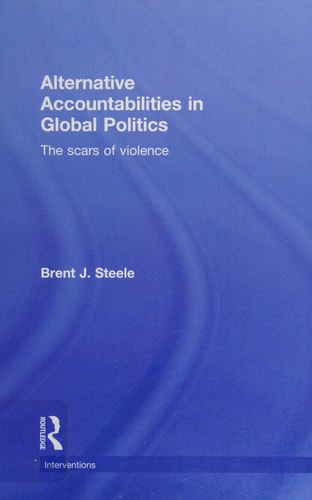
Alternative Accountabilities in Global Politics: The Scars of Violence
0
0
As an Amazon Associate and affiliate partner, Menrva Books earns from qualifying purchases. Learn more
Author Description
In fields such as politics, international relations, public administration and international law, there is a rapidly growing interest in the topic of 'accountability'. In this innovative new work, Steele shows how we might recognize how an alternative form of accountability in global politics has been present for some time, and that, furthermore, this form's continued presence remains one of the most politically powerful, if not endurable, possibilities for resistance in the near future. This book argues that the physical and visually shocking outcomes of violence found on the bodies of humans, as well as the buildings and landscapes which surround us, specifically the scars they leave behind, remain one of our most compelling forms of accountability. Steele develops the theoretical argument on scars and exteriority utilizing insights from several philosophical and theoretical resources including Hannah Arendt, Erving Goffmann, and Richard Rorty. The work examines scars and their effects through several illustrations, including the accounts of Emmett Till, Iranian protestor Neda Agha-Soltan, the Syrian boy Hamza al-Khateeb, the massacre in WWII and then memorializing throughout the 20th century of the Lidice children in the modern-day Czech Republic, the particular architecturally destructive outcomes of the 2008-9 Gaza War, the loss of the Twin Towers in New York, as well as a variety of violent scars found on the landscapes of Europe and Southeast Asia. Emphasizing the importance of the space and 'time' of scars, the book illustrates how an alternative form of accountability in the scar can be a useful, disruptive, spontaneous, but also creative practice to challenge the discourses of violence which remain with us today.
Menrva's Summary
THE THESIS
How can the physical and visual remnants of violence serve as a form of accountability in global politics? Brent J. Steele, a scholar of international relations, posits that scars—whether on human bodies, architecture, or landscapes—function as a persistent, disruptive mechanism for political resistance. By synthesizing philosophical frameworks from thinkers like Hannah Arendt, Erving Goffman, and Richard Rorty, the author argues that these visible markers of trauma challenge dominant political discourses and offer a spontaneous, creative practice for holding power to account.
THE SCOPE MAP
What You Will Find
- Theoretical framework connecting physical exteriority to political accountability.
- Case studies including the death of Emmett Till and Neda Agha-Soltan.
- Analysis of architectural destruction in the 2008-9 Gaza War and the loss of the Twin Towers.
- Examination of memorialization practices, specifically the Lidice children in the Czech Republic.
- Exploration of the temporal and spatial dimensions of violent scars on global landscapes.
THE AUTHORITY PERSPECTIVE
Scholars in international relations and political theory identify this work as a significant contribution to the study of political violence and memory. Readers frequently note the dense, philosophical nature of the prose, which requires familiarity with the cited theorists to fully grasp the author's conceptual framework.
Page Count:
193
Publication Date:
2012-01-01
Publisher:
Routledge
ISBN-10:
0203082443
ISBN-13:
9780203082447
Philosophy
International relations
Human rights
Sociology
Moral and ethical aspects
Community Tags
Other Editions(3)


Similar Books




Reader Comments
Share Your Thoughts
No comments yet. Be the first to share your thoughts!