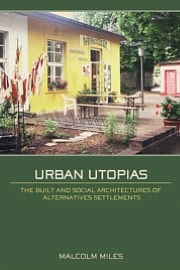
Urban Utopias: The Built and Social Architectures of Alternative Settlements
0
0
As an Amazon Associate and affiliate partner, Menrva Books earns from qualifying purchases. Learn more
Author Description
Utopia tends to generate a bad press - regarded as impracticable, perhaps nostalgic, or contradictory when visions of a perfect world cannot accommodate the change that is necessary to a free and self-organizing society. But people from diverse backgrounds are currently building a new society within the old, balancing literal and metaphorical utopianism, and demonstrating plural possibilities for alternative futures and types of settlement. Thousands of such places exist around the world, including intentional communities, eco-villages, permaculture plots, religious and secular retreats, co-housing projects, self-build schemes, projects for low-impact housing, and activist squats in urban and rural sites. This experience suggests, however, that when planning and design are not integral to alternative social formations, the modern dream to engineer a new society cannot be realized.The book is structured in four parts. In part one, literary and theoretical utopias from the early modern period to the nineteenth-century are reconsidered. Part two investigates twentieth-century urban utopianism and contemporary alternative settlements focusing on social and environmental issues, activism and eco-village living. Part three looks to wider horizons in recent practices in the non-affluent world, and Part four reviews a range of cases from the author’s visits to specific sites. This is followed by a short conclusion in which a discussion of key issues is resumed.This book brings together insights from literary, theoretical and practical utopias, drawing out the characteristics of groups and places that are part of a new society. It links today’s utopian experiments to historical and literary utopias, and to theoretical problems in utopian thought.
Menrva's Summary
THE THESIS
This book investigates whether the modern dream of engineering a new society can be realized when planning and design are not integrated into alternative social formations. Malcolm Miles, a scholar in cultural theory and urban design, examines the intersection of historical utopian theory and contemporary practical experiments. By analyzing the tension between literal and metaphorical utopianism, the author argues that successful alternative settlements require a synthesis of social organization and physical design.
THE SCOPE MAP
What You Will Find
- A historical review of literary and theoretical utopias from the early modern period to the nineteenth century.
- An analysis of twentieth-century urban utopianism and contemporary eco-village movements.
- Case studies derived from the author's direct site visits to various intentional communities and activist squats.
- A critical framework linking current social experiments to broader theoretical problems in utopian thought.
THE AUTHORITY PERSPECTIVE
Experts recognize this work as a comprehensive bridge between abstract utopian philosophy and the material reality of modern alternative settlements. Readers frequently note the academic density of the prose, which serves as a foundational text for those interested in the intersection of urban design and social activism.
Page Count:
288
Publication Date:
2007-01-01
Publisher:
Taylor & Francis Group
ISBN-10:
0203099125
ISBN-13:
9780203099124
Architecture
urban planning
Sociology
Utopias
Social Science
Community Tags
Similar Books