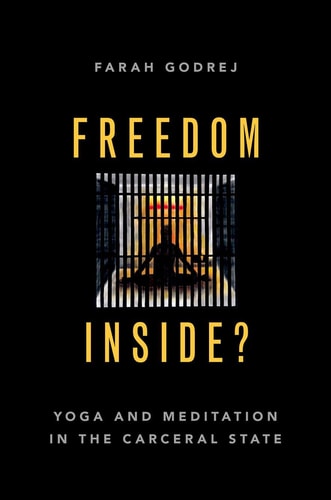
Freedom Inside?: Yoga and Meditation in the Carceral State
0
0
As an Amazon Associate and affiliate partner, Menrva Books earns from qualifying purchases. Learn more
Author Description
An estimated forty million people in the United States regularly practice yoga, and as an industry it generates over nine billion dollars annually. A major reason for its popularity is its promise of mental and physical well-being: yoga and meditation are thought to be spiritual paths to self-improvement. Yoga is also widely practiced in prisons, another large business in the United States. Prisons in all fifty states offer yoga and meditation as a form of rehabilitation. But critics argue that such practices can also have disempowering effects, due to their emphasis on acceptance, non-judgment, and non-reaction. If the root of suffering is in the mind, as the philosophy behind yoga and meditation suggests, then injustice (including mass incarceration) may be reduced to a mental state requiring coping techniques rather than a more critical mindset. Others insist that yoga can heighten people's attention to structural violence, hierarchy, racism, and inequity. In fact, some of history's most radical activists, including M.K. Gandhi and Thich Nhat Hanh, traced their ethical and political commitments to their grounding in yogic or meditative traditions.Yoga and meditation programs no doubt offer crucial respite for those who are incarcerated, but what sort of political effects do they have? Do they reinforce the neoliberal logic of mass incarceration which emphasizes individual choices, or can they assist marginalized people in navigating systemic injustice? Drawing on collaborations with incarcerated practitioners, interviews with volunteers and formerly incarcerated practitioners, and her own fieldwork with organizations offering yoga/meditation classes inside prisons, Farah Godrej examines both the promises and pitfalls of yoga and meditation. Freedom Inside? reveals the ways in which incarcerated persons have used yogic practices to resist the dehumanizing effects of prisons, and to heighten their awareness of institutional racism and mass incarceration among poor
Menrva's Summary
THE THESIS
This book investigates the political implications of yoga and meditation programs within the United States carceral system, questioning whether these practices facilitate personal coping or foster critical awareness of systemic injustice. Farah Godrej, a political theorist, utilizes a combination of ethnographic fieldwork, qualitative interviews, and historical analysis to evaluate the intersection of neoliberal self-improvement rhetoric and the realities of mass incarceration. The work challenges the assumption that these practices are inherently apolitical, arguing instead that their impact depends heavily on how they are framed and implemented within the prison environment.
THE SCOPE MAP
What You Will Find
- Analysis of the neoliberal logic underpinning prison rehabilitation programs.
- Examination of the historical connection between meditative traditions and radical political activism.
- Fieldwork data gathered from organizations providing yoga and meditation inside correctional facilities.
Scope Limits
- The study focuses primarily on the United States carceral system and may not account for global variations in prison-based yoga programs.
- It does not provide a clinical assessment of the psychological efficacy of yoga for mental health, focusing instead on political and social outcomes.
THE AUTHORITY PERSPECTIVE
Scholars in sociology and political science recognize this work as a critical intervention in the study of carceral rehabilitation programs. Experts highlight the author's ability to balance the personal benefits reported by incarcerated individuals with a rigorous critique of the structural forces that shape these programs.
Page Count:
368
Publication Date:
2022-07-01
Publisher:
Oxford University Press
ISBN-10:
0190070099
ISBN-13:
9780190070090
Politics
Philosophy
Systems Theory
Social Science
New Used & Rental Textbooks
Comparative
Yoga
Politics & Government
Criminology
Political
Meditation
Social justice
Sociology
Community Tags
Similar Books