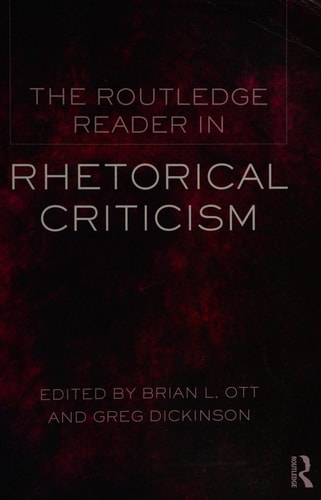
Routledge Reader in Rhetorical Criticism
0
0
As an Amazon Associate and affiliate partner, Menrva Books earns from qualifying purchases. Learn more
Author Description
Bringing together over 40 key readings on rhetorical criticism in a single accessible format, The Rhetorical Criticism Reader furnishes instructors with an ideal resource for teaching and practicing the art of rhetorical criticism. Unlike existing readers and textbooks, which rely on cookie-cutter approaches to rhetorical criticism, The Rhetorical Criticism Reader organizes the field conceptually, allowing teachers and students to grapple with the enduring issues and debates surrounding criticism over the past 50 years. The readings are organized around four sections of conceptual issues and debates in rhetorical criticism: critic/purpose, object/method, theory/practice, and audience/consequentiality. Each section is preceded by an introductory essay that puts each reading into context. For added flexibility, an alternative table of contents is also included for instructors and students to customize their teaching and reading.Intended for upper-division undergraduate and graduate courses in rhetorical criticism, The Rhetorical Criticism Reader uniquely lends itself to thoughtful discussion of the role of the critic in the critical process. It assists readers not only in learning the tools of criticism, but also in reflecting on the values that underlie the critical endeavor
Menrva's Summary
THE THESIS
This volume investigates the foundational debates and evolving methodologies that define the field of rhetorical criticism over the last half-century. Brian L. Ott and Greg Dickinson, both established scholars in communication studies, curate a collection of seminal texts designed to move beyond prescriptive, formulaic approaches to analysis. By organizing the material conceptually rather than chronologically, the authors provide a framework that encourages students to interrogate the relationship between the critic, the object of study, and the broader social consequences of rhetorical practice.
THE SCOPE MAP
What You Will Find
- Conceptual organization covering critic/purpose, object/method, theory/practice, and audience/consequentiality.
- Introductory essays for each section that contextualize the selected readings.
- An alternative table of contents to facilitate customized pedagogical approaches.
- A comprehensive selection of over 40 key readings representing diverse perspectives in rhetorical theory.
THE AUTHORITY PERSPECTIVE
Instructors frequently identify this text as a primary resource for upper-division undergraduate and graduate courses due to its thematic structure. Experts note that the book successfully shifts the focus from rote memorization of methods to a more reflective engagement with the values inherent in critical practice.
Page Count:
0
Publication Date:
2012-08-01
Publisher:
Routledge
ISBN-10:
0203098277
ISBN-13:
9780203098271
Academic
Rhetoric
Communication
Education
Reference
Community Tags
Similar Books