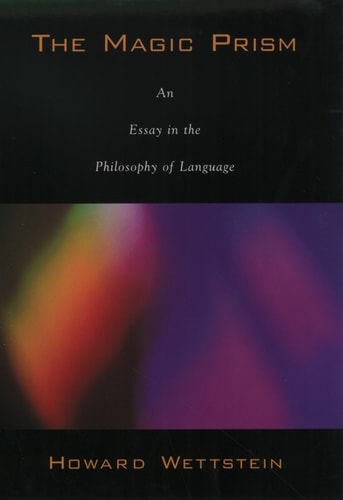
The Magic Prism: An Essay in the Philosophy of Language
0
0
As an Amazon Associate and affiliate partner, Menrva Books earns from qualifying purchases. Learn more
Author Description
The late 20th century saw great movement in the philosophy of language, often critical of the fathers of the subject--Gottlieb Frege and Bertrand Russell--but sometimes supportive of (or even defensive about) the work of the fathers. Howard Wettstein's sympathies lie with the critics. But he says that they have often misconceived their critical project, treating it in ways that are technically focused and that miss the deeper implications of their revolutionary challenge. Wettstein argues that Wittgenstein--a figure with whom the critics of Frege and Russell are typically unsympathetic--laid the foundation for much of what is really revolutionary in this late 20th century movement. The subject itself should be of great interest, since philosophy of language has functioned as a kind of foundation for much of 20th century philosophy. But in fact it remains a subject for specialists, since the ideas are difficult and the mode of presentation is often fairly technical. In this book, Wettstein brings the non-specialist into the conversation (especially in early chapters); he also reconceives the debate in a way that avoids technical formulation. The Magic Prism is intended for professional philosophers, graduate students, and upper division undergraduates.
Menrva's Summary
THE THESIS
The book investigates the core question of how the late 20th-century critique of Frege and Russell can be reinterpreted to reveal deeper philosophical implications beyond mere technical analysis. Howard Wettstein, a scholar in the field, utilizes historical analysis and philosophical argumentation to challenge the prevailing view that the critique of early analytic philosophy was purely technical. He posits that Ludwig Wittgenstein provided the necessary foundation for this movement, arguing that the subject matter should be accessible to a broader audience rather than restricted to specialists.
THE SCOPE MAP
What You Will Find
- A historical overview of the 20th-century philosophy of language
- A critical re-evaluation of the works of Frege, Russell, and Wittgenstein
- A non-technical framework for understanding complex linguistic debates
Scope Limits
- The book does not provide an exhaustive history of all linguistic theories
- It does not focus on formal logic or mathematical notation
THE AUTHORITY PERSPECTIVE
Experts recognize this work as a significant attempt to bridge the gap between specialized analytic philosophy and broader philosophical inquiry. Readers frequently note the author's success in stripping away dense technical jargon to expose the underlying conceptual challenges of the field.
Page Count:
253
Publication Date:
2004-01-01
Publisher:
Oxford University Press
ISBN-10:
0190289619
ISBN-13:
9780190289614
Philosophy
Linguistics
Academic
Philosophy of
English & College Success
English
Epistemology
Community Tags
Similar Books