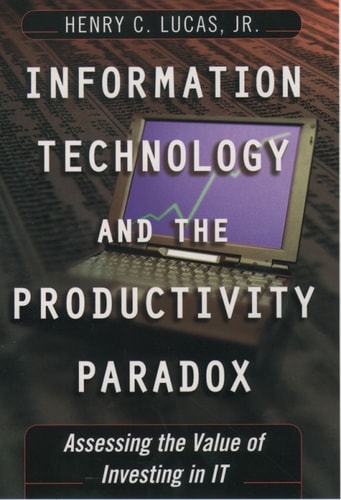
Information Technology and the Productivity Paradox: Assessing the Value of Investing in IT
0
0
As an Amazon Associate and affiliate partner, Menrva Books earns from qualifying purchases. Learn more
Author Description
From networks to databases, email to voicemail, the amount of capital being invested in information technology each year is staggering. By 1996, U.S. firms were spending more than $500 billion annually on software, networks and staff. The recently merged Bank of America and NationsBank have an initial IT budget of 4 billion dollars. As firms like this push rapidly into the business world of the 21st century, the question has remained: how do firms measure returns from these substantial investments in information technology? Henry C. Lucas, effectively answers this question by providing a creative and reliable framework for measuring the competitive advantages and profits gained through investments in state-of-the-art information systems. There is value in information technology, and it is possible to show returns, Lucas argues--unfortunately this value just doesn't always show up clearly on the bottom line of a ledger. In five expertly presented sections, he spells out exactly what businesses can expect from their information technology investments--some investments create a measurable value, some do not, but all are important nonetheless. Through a precise mix of frameworks and models, such as an Investment Opportunities Matrix, and punctuated with real examples from successful firms, this is the first book to allow executives to see exactly how their information technology investment can be expected to return value, thereby maximizing their advantages in an age of global competitiveness. Indeed, firms who manage their information systems most efficiently are best suited to succeed in a rapidly evolving marketplace. With so much at stake, Information Technology is certain to be the essential guide for firms determined to compete and flourish in the highly competitive economy of the next century.
Menrva's Summary
THE THESIS
This book investigates the persistent difficulty in quantifying the financial returns on massive corporate investments in information technology. Henry C. Lucas Jr., a professor and expert in information systems, utilizes a combination of economic theory and organizational case studies to address the 'productivity paradox.' He argues that while IT value is often obscured in traditional accounting, it manifests through competitive advantages and operational efficiencies that can be measured using specific strategic frameworks.
THE SCOPE MAP
What You Will Find
- Investment Opportunities Matrix for evaluating IT projects
- Frameworks for linking technology deployment to competitive advantage
- Case studies of large-scale corporate IT implementation
- Analysis of the relationship between IT spending and firm profitability
Scope Limits
- Focuses primarily on large-scale corporate environments rather than small business or startup contexts
- Does not provide a technical guide for software or hardware implementation
THE AUTHORITY PERSPECTIVE
Experts recognize this work as a foundational text for understanding the strategic alignment of IT investments within large organizations. Readers frequently note that while the data reflects the economic landscape of the late 1990s, the underlying management frameworks remain relevant for evaluating modern digital transformation projects.
Page Count:
235
Publication Date:
1999-01-01
Publisher:
Oxford University Press
ISBN-10:
0190283955
ISBN-13:
9780190283957
Economics
Business
MIS
Information Management
Management
Professional Career & Trade
Corporate Strategy
Principles of Management
Information Technology
Community Tags
Similar Books