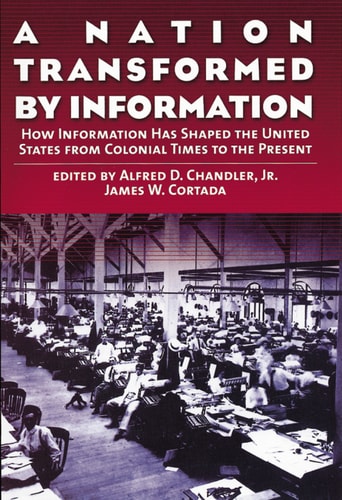
A Nation Transformed by Information: How Information Has Shaped the United States from Colonial Times to the Present
0
0
As an Amazon Associate and affiliate partner, Menrva Books earns from qualifying purchases. Learn more
Author Description
This book makes the startling case that North Americans were getting on the "information highway" as early as the 1700's, and have been using it as a critical building block of their social, economic, and political world ever since.By the time of the founding of the United States, there was a postal system and roads for the distribution of mail copyright laws to protect intellectual property, and newspapers, books, and broadsides to bring information to a populace that was building a nation on the basis of an informed electorate. In the 19th century, Americans developed the telegraph, telephone, and motion pictures, inventions that further expanded the reach of information. In the 20th century they added television, computers, and the Internet, ultimately connecting themselves to a whole world of information.From the beginning North Americans were willing to invest in the infrastructure to make such connectivity possible. This book explores what the deployment of these technologies says about American society. The editors assembled a group of contributors who are experts in their particular fields and worked with them to create a book that is fully integrated and cross-referenced.
Menrva's Summary
THE THESIS
This work investigates how the continuous development and adoption of information infrastructure has functioned as a foundational element in the social, economic, and political evolution of the United States. Editors Alfred D. Chandler and James W. Cortada, both distinguished historians of business and technology, curate a collection of expert essays to argue that American progress is inextricably linked to the systematic expansion of information networks. By examining the transition from colonial postal systems to the modern digital age, the authors demonstrate that the American commitment to connectivity has consistently shaped national identity and institutional growth.
THE SCOPE MAP
What You Will Find
- Historical analysis of communication technologies including the telegraph, telephone, and motion pictures.
- Examination of the legal and social frameworks supporting information distribution, such as copyright laws and the postal system.
- Integrated case studies covering the 18th, 19th, and 20th centuries.
Scope Limits
- The text focuses primarily on the United States and does not provide a global comparative analysis of information infrastructure.
- It does not offer technical manuals or detailed engineering specifications for the technologies discussed.
THE AUTHORITY PERSPECTIVE
Scholars and historians frequently cite this volume as a comprehensive resource for understanding the intersection of American history and information technology. Readers often note the academic rigor of the contributors and the effectiveness of the cross-referenced structure in providing a cohesive narrative across centuries.
Page Count:
391
Publication Date:
2000-01-01
Publisher:
Oxford University Press
ISBN-10:
0190284439
ISBN-13:
9780190284435
History
Technology
Sociology
American History
Economics history
Information society
Information Science
United States
Communication
Community Tags
Similar Books