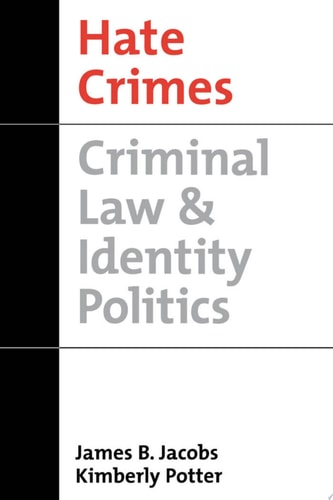
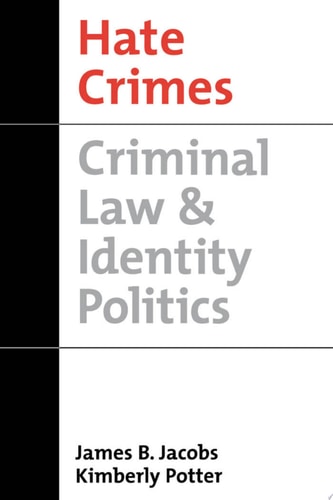
Hate Crimes: Criminal Law and Identity Politics
0
0
As an Amazon Associate and affiliate partner, Menrva Books earns from qualifying purchases. Learn more
Author Description
In the early 1980s, a new category of crime appeared in the criminal law lexicon. In response to concerted advocacy-group lobbying, Congress and many state legislatures passed a wave of "hate crime" laws requiring the collection of statistics on, and enhancing the punishment for, crimes motivated by certain prejudices. This book places the evolution of the hate crime concept in socio-legal perspective. James B. Jacobs and Kimberly Potter adopt a skeptical if not critical stance, maintaining that legal definitions of hate crime are riddled with ambiguity and subjectivity. No matter how hate crime is defined, and despite an apparent media consensus to the contrary, the authors find no evidence to support the claim that the United States is experiencing a hate crime epidemic--instead, they cast doubt on whether the number of hate crimes is even increasing. The authors further assert that, while the federal effort to establish a reliable hate crime accounting system has failed, data collected for this purpose have led to widespread misinterpretation of the state of intergroup relations in this country. The book contends that hate crime as a socio-legal category represents the elaboration of an identity politics now manifesting itself in many areas of the law. But the attempt to apply the anti-discrimination paradigm to criminal law generates problems and anomalies. For one thing, members of minority groups are frequently hate crime perpetrators. Moreover, the underlying conduct prohibited by hate crime law is already subject to criminal punishment. Jacobs and Potter question whether hate crimes are worse or more serious than similar crimes attributable to other anti-social motivations. They also argue that the effort to single out hate crime for greater punishment is, in effect, an effort to punish some offenders more seriously simply because of their beliefs, opinions, or values, thus implicating the First Amendment. Advancing a provocative argument in clear and persua
Menrva's Summary
THE THESIS
This book investigates the socio-legal evolution of hate crime legislation and questions the validity of the claim that the United States is experiencing a hate crime epidemic. James B. Jacobs and Kimberly Potter, both scholars in law and sociology, utilize historical legislative data and statistical analysis to challenge the prevailing consensus surrounding hate crime laws. They argue that these laws are conceptually flawed, prone to subjective application, and potentially in conflict with First Amendment protections regarding freedom of thought and expression.
THE SCOPE MAP
What You Will Find
- Historical analysis of the emergence of hate crime laws in the 1980s
- Critique of federal and state data collection methodologies
- Examination of the intersection between identity politics and criminal law
- Legal arguments regarding the proportionality of punishment and constitutional rights
Scope Limits
- Does not provide an exhaustive catalog of every state-level hate crime statute
- Does not focus on the psychological profiles of individual offenders
THE AUTHORITY PERSPECTIVE
Legal scholars and criminologists frequently cite this work as a foundational critical text for understanding the skepticism surrounding the expansion of hate crime legislation. Readers often note the academic density of the prose and the authors' rigorous, albeit controversial, challenge to established public policy narratives.
Page Count:
219
Publication Date:
2000-01-01
Publisher:
Oxford University Press
ISBN-10:
0190286318
ISBN-13:
9780190286316
Law
Criminology
Public Policy
Sociology
Hate crimes
Professional Career & Trade
Community Tags
Other Editions(2)
Similar Books










Reader Comments
Share Your Thoughts
No comments yet. Be the first to share your thoughts!