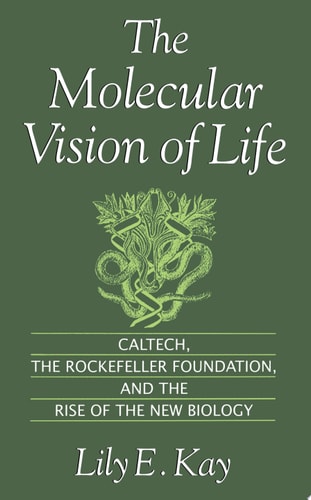
The Molecular Vision of Life: Caltech, the Rockefeller Foundation, and the Rise of the New Biology
0
0
As an Amazon Associate and affiliate partner, Menrva Books earns from qualifying purchases. Learn more
Author Description
This fascinating study examines the rise of American molecular biology to disciplinary dominance, focusing on the period between 1930 and the elucidation of DNA structure in the mid 1950s. Research undertaken during this period, with its focus on genetic structure and function, endowed scientists with then unprecedented power over life. By viewing the new biology as both a scientific and cultural enterprise, Lily E. Kay shows that the growth of molecular biology was a result of systematic efforts by key scientists and their sponsors to direct the development of biological research toward a shared vision of science and society. She analyzes the motivations and mechanisms empowering this vision by focusing on two key institutions: Caltech and its sponsor, the Rockefeller Foundation. Her study explores a number of vital, sometimes controversial topics, among them the role of private power centers in shaping scientific agenda, and the political dimensions of "pure" research. It also advances a sobering argument: the cognitive and social groundwork for genetic engineering and human genome projects was laid by the American architects of molecular biology during these early decades of the project. This book will be of interest to molecular biologists, historians, sociologists, and the general reader alike.
Menrva's Summary
THE THESIS
This book investigates how the institutional alliance between Caltech and the Rockefeller Foundation facilitated the rise of molecular biology as a dominant scientific discipline between 1930 and the 1950s. Lily E. Kay, a historian of science, utilizes archival records and institutional correspondence to argue that the development of molecular biology was not an inevitable scientific progression but a directed project. She posits that private funding and strategic institutional planning shaped the cognitive and social frameworks that eventually enabled modern genetic engineering.
THE SCOPE MAP
What You Will Find
- Analysis of the Rockefeller Foundation's funding strategies in the mid-20th century
- Historical examination of the research programs at Caltech
- Exploration of the intersection between scientific research and social engineering
- Discussion of the political dimensions of supposedly objective scientific inquiry
Scope Limits
- The study focuses primarily on the American context and does not provide a global history of molecular biology
- The narrative concludes in the mid-1950s and does not cover subsequent developments in biotechnology
THE AUTHORITY PERSPECTIVE
Scholars in the history and philosophy of science frequently cite this work as a foundational text for understanding the political economy of scientific research. Readers often note the academic density of the prose, which requires a background in the history of biology to fully appreciate the nuanced institutional analysis.
Page Count:
311
Publication Date:
1992-01-01
Publisher:
Oxford University Press
ISBN-10:
0190281618
ISBN-13:
9780190281618
History
Non-Fiction
Academic
Science History
California Institute Of Technology
Sociology of Science
Earth Sciences