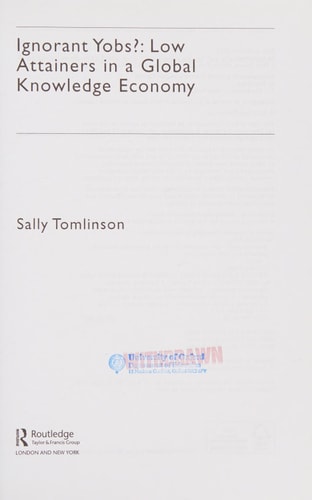
Ignorant Yobs?: Low Attainers in a Global Knowledge Economy
0
0
As an Amazon Associate and affiliate partner, Menrva Books earns from qualifying purchases. Learn more
Author Description
What happens to young people who are defined as lower attainers or having learning difficulties in a global knowledge economy? How do we stop those with learning difficulties or disabilities being seen as social problems or simply as consumers of resources? Governments in developed countries are driven by the belief that in a global economy all citizens should be economically productive, yet they are still not clear about the relationship between the education of low attainers and the labour market. Ignorant Yobs?: Low Attainers in a Global Knowledge Economy examines this international phenomenon, exploring how those with learning difficulties are treated in a world economy where even low-skilled jobs require qualifications. This unique book provides an examination of countries which converge on the issue of the low attaining population, despite differing on political, economic and cultural dimensions.In doing so, it considers some thorny issues at the forefront of education policy and provision: The increasing competitive stratification within education systems; The impact of governments who have put competition in the labour market at the heart of their policies; Social control of potentially disruptive groups, social cohesion and the human rights agenda; The expansion of a special education industry driven by the needs of middle class, aspirant and knowledgeable parents, anxious about the success of their 'less able' children. Written by an internationally renowned scholar, Ignorant Yobs?: Low Attainers in a Global Knowledge Economy synthesises a range of complex, highly topical issues and suggests how those with learning difficulties might, with government and employer support, contribute to a flexible labour market.This book, using original discussions in England, the USA, Germany, Malta and Finland, will be of interest to a wide audience of policy-makers, practitioners, administrators, and politicians, in addition to undergraduate, postgraduate and research students.
Menrva's Summary
THE THESIS
This book investigates the systemic marginalization of low-attaining students and individuals with learning disabilities within the competitive framework of a global knowledge economy. Sally Tomlinson, a renowned scholar in education policy, utilizes comparative analysis across several developed nations to examine how government policies prioritize economic productivity over inclusive educational support. The text argues that current systems often categorize these individuals as social burdens rather than potential contributors, highlighting a disconnect between labor market demands and educational provision.
THE SCOPE MAP
What You Will Find
- Comparative analysis of education and labor policies in England, the USA, Germany, Malta, and Finland.
- Examination of the stratification of education systems driven by global economic competition.
- Analysis of the special education industry and the influence of parental advocacy on policy.
- Discussion of the tension between social control, human rights, and the integration of low-attaining populations into the workforce.
THE AUTHORITY PERSPECTIVE
Experts recognize this work as a critical contribution to the sociology of education, particularly for its international perspective on policy-making. Readers frequently note the academic density of the prose and its utility for policy-makers and researchers examining the intersection of disability, education, and labor economics.
Page Count:
151
Publication Date:
2013-01-01
Publisher:
Routledge
ISBN-10:
0415525764
ISBN-13:
9780203119747
Economics
Education
Public Policy
People with Disabilities
Sociology
Special Education
Labor Market
Community Tags
Other Editions(4)



Similar Books






Reader Comments
Share Your Thoughts
No comments yet. Be the first to share your thoughts!