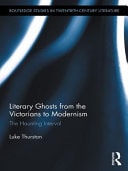
Literary Ghosts: From the Victorians to Modernism
0
0
As an Amazon Associate and affiliate partner, Menrva Books earns from qualifying purchases. Learn more
Author Description
This book resituates the ghost story as a matter of literary hospitality and as part of a vital prehistory of modernism, seeing it not as a quaint neo-gothic ornament, but as a powerful literary response to the technological and psychological disturbances that marked the end of the Victorian era. Linking little-studied authors like M. R. James and May Sinclair to such canonical figures as Dickens, Henry James, Woolf, and Joyce, Thurston argues that the literary ghost should be seen as no mere relic of gothic style but as a portal of discovery, an opening onto the central modernist problem of how to write 'life itself'. Ghost stories should be seen as a distinctly neo-gothic genre, and as such are split between an ironic, often parodic reference to Gothic style and an evocation of 'life itself,' an implicit repudiation of all literary style. Reading the ghost story as both a guest and a host story, this book traces the ghost as a disruptive figure in the 'hospitable' space of narrative from Maturin, Poe and Dickens to the fin de siècle, and then on into the twentieth century.
Menrva's Summary
THE THESIS
This book investigates the ghost story as a critical site of literary hospitality and a vital prehistory to the development of modernism. Luke Thurston, an academic scholar, examines the ghost story not as a mere gothic ornament, but as a sophisticated response to the technological and psychological shifts of the late Victorian era. By analyzing the intersection of narrative structure and the supernatural, the author argues that the ghost serves as a portal for modernist writers to address the challenge of representing life itself.
THE SCOPE MAP
What You Will Find
- A comparative analysis of authors ranging from Maturin and Poe to Dickens, M. R. James, May Sinclair, Woolf, and Joyce.
- A theoretical framework defining the ghost story as a tension between ironic gothic parody and the pursuit of unmediated life.
- An examination of the ghost as a disruptive figure within the hospitable space of narrative.
- A historical trajectory tracing the evolution of the ghost story from the Victorian era into the twentieth century.
THE AUTHORITY PERSPECTIVE
Scholars and critics recognize this work as a significant contribution to the study of the ghost story's role in the transition to modernism. Readers frequently note the academic density of the prose and the author's ability to bridge the gap between canonical modernist figures and lesser-studied gothic writers.
Page Count:
186
Publication Date:
2012-01-01
Publisher:
Taylor & Francis Group
ISBN-10:
0203112490
ISBN-13:
9780203112496
Literary Criticism
Modernism
In literature
Moderne
Gothic Romance
Gespenst
European
Victorian
English literature
Bellettrie
Gothic
Literatur
Engels
Literary History
Community Tags
Similar Books