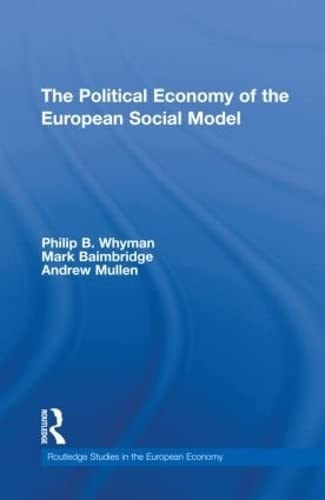
The Political Economy of the European Social Model
0
0
As an Amazon Associate and affiliate partner, Menrva Books earns from qualifying purchases. Learn more
Author Description
This book seeks to analyse the development of the European Union (EU), which was founded upon the principle of the free movement of capital, goods, services and people in 1957. Its central thesis is that, from a practical and theoretical point of view, such a basis is fundamentally at odds with the creation of an interventionist regime that the construction of a social Europe would require.The authors argue convincingly that - economically: the EU does not currently possess the budget or the economic tools to pursue such a strategy; politically: close to none of the institutions of the EU have backed such a policy; practically: conservative and neo-liberal forces (among member states and the institutions of the EU) have repeatedly thwarted any moves in this direction. In reality, the Single Internal Market, Economic and Monetary Union, enlargement, the Lisbon Agenda and European Constitution projects all prioritise supply-side measures and expanding the scope of the market rather than the boosting of demand and other economic intervention. Consequently, constructing a social Europe in the face of this would appear problematic. Hence, in both theory and practice, the idea that there can be a social Europe vis-à-vis neoliberalisation is a contradiction in terms.This controversial book will be an educating and refreshing read for advanced students and academics involved with European politics, the European Union, European Economics and Economic instititutions.
Menrva's Summary
THE THESIS
This book investigates the fundamental incompatibility between the European Union's foundational commitment to free-market principles and the potential for establishing a robust, interventionist social model. Philip Whyman, an expert in European economic policy, utilizes a critical analysis of EU institutional history and economic frameworks to argue that the current trajectory of the Union prioritizes neoliberal expansion over social welfare. The author systematically examines how the structural constraints of the Single Internal Market and the Economic and Monetary Union effectively preclude the implementation of a cohesive social Europe.
THE SCOPE MAP
What You Will Find
- Analysis of the historical development of the EU from 1957 to the present.
- Evaluation of the Lisbon Agenda and the European Constitution projects.
- Examination of the tension between supply-side economic measures and demand-side intervention.
- Critique of the political and institutional barriers to social policy integration.
THE AUTHORITY PERSPECTIVE
Experts recognize this work as a rigorous critique of European integration that challenges mainstream assumptions regarding the EU's social potential. Readers frequently note the academic density of the prose, making it a specialized resource for students and scholars of political economy.
Page Count:
398
Publication Date:
2012-01-01
Publisher:
Routledge
ISBN-10:
0203113306
ISBN-13:
9780203113301
Economics
International relations
European Union
Public Policy
Community Tags
Similar Books