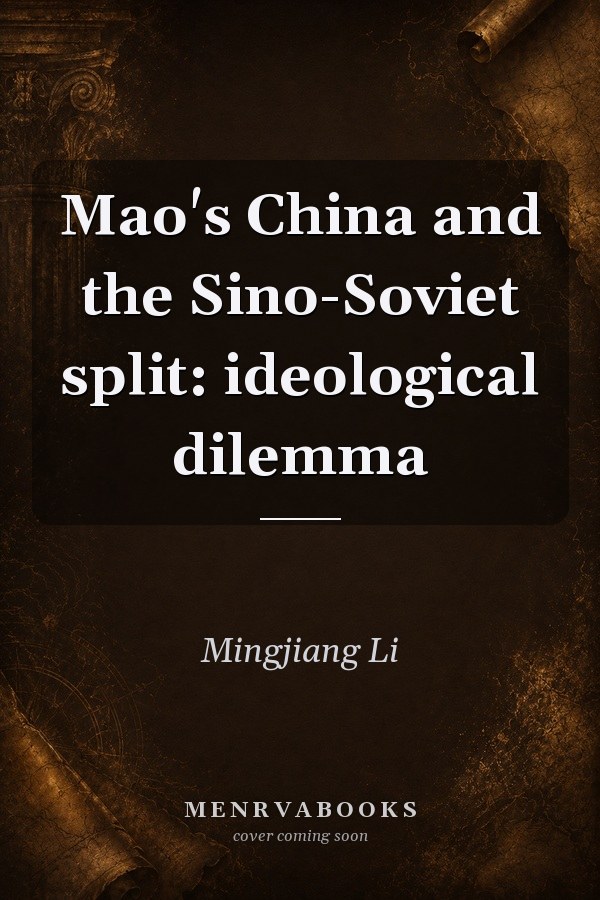
Mao's China and the Sino-Soviet Split: Ideological Dilemma
0
0
As an Amazon Associate and affiliate partner, Menrva Books earns from qualifying purchases. Learn more
Author Description
Machine Generated Contents Note: 1. Introduction -- 2. Ideological Dilemma In International Politics -- 3. The Soviet 20th Party Congress And Emerging Disputes In 1958 -- 4. Mao's Great Leap Forward And Sino-soviet Disputes, 1959-1960 -- 5. Temporary Calm And Deterioration In Relations, 1960-1962 -- 6. The Growth Of Domestic Radicalism And Polemics With Moscow, 1963-1964 -- 7. Short-lived Detente And The End Of Party Relations, 1965-1966 -- 8. Sino-soviet Confrontation During The Cultural Revolution, 1966-1969 -- 9. Conclusions. Mingjiang Li. Includes Bibliographical References And Index.
Menrva's Summary
THE THESIS
This work investigates how Mao Zedong's domestic ideological shifts and radicalization directly fueled the deterioration of the Sino-Soviet alliance during the mid-twentieth century. Mingjiang Li, a scholar specializing in Chinese foreign policy, utilizes archival research and historical analysis to argue that the split was not merely a geopolitical power struggle, but a fundamental clash over the interpretation of Marxist-Leninist doctrine. The book examines how Mao’s internal policy experiments, such as the Great Leap Forward, necessitated a break from Moscow’s influence to maintain domestic political legitimacy.
THE SCOPE MAP
What You Will Find
- A chronological analysis of Sino-Soviet relations from 1958 to 1969.
- Examination of the impact of the Soviet 20th Party Congress on Chinese leadership.
- Analysis of how domestic radicalism during the Cultural Revolution influenced foreign policy.
- A framework for understanding the intersection of ideology and international diplomacy.
THE AUTHORITY PERSPECTIVE
Experts recognize this text as a rigorous examination of the ideological underpinnings of the Sino-Soviet split. Scholars frequently note the academic density of the prose and the author's meticulous use of historical documentation to support his arguments.
Page Count:
224
Publication Date:
2012-01-01
Publisher:
Routledge
ISBN-10:
0203126327
ISBN-13:
9780203126325
History
Cold War
International relations
Communism
Soviet Union
China
Community Tags
Similar Books