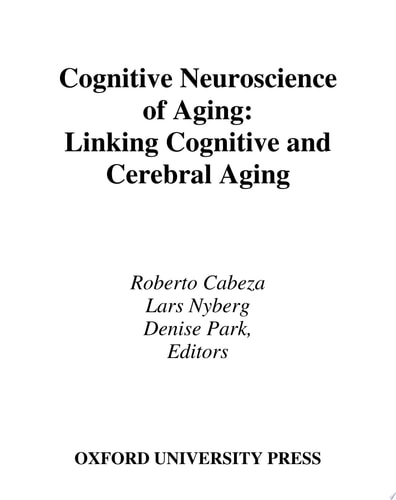
Cognitive Neuroscience of Aging: Linking Cognitive and Cerebral Aging
0
0
As an Amazon Associate and affiliate partner, Menrva Books earns from qualifying purchases. Learn more
Author Description
Until very recently, our knowledge about the neural basis of cognitive aging was based on two disciplines that had very little contact with each other. Whereas the neuroscience of aging investigated the effects of aging on the brain independently of age-related changes in cognition, the cognitive psychology of aging investigated the effects of aging on cognition independently of age-related changes in the brain. The lack of communication between these two disciplines is currently being addressed by an increasing number of studies that focus on the relationships between cognitive aging and cerebral aging. This rapidly growing body of research has come to constitute a new discipline, which may be called cognitive neuroscience of aging. The goal of Cognitive Neuroscience of Aging is to introduce the reader to this new discipline at a level that is useful to both professionals and students in the domains of cognitive neuroscience, cognitive psychology, neuroscience, neuropsychology, neurology, and other, related areas.This book is divided into four main sections. The first section describes noninvasive measures of cerebral aging, including structural (e.g., volumetric MRI), chemical (e.g., dopamine PET), electrophysiological (e.g., ERPs), and hemodynamic (e.g., fMRI), and discusses how they can be linked to behavioral measures of cognitive aging. The second section reviews evidence for the effects of aging on neural activity during different cognitive functions, including perception and attention, imagery, working memory, long-term memory, and prospective memory. The third section focuses on clinical and applied topics, such as the distinction between healthy aging and Alzheimers disease and the use of cognitive training to ameliorate age-related cognitive decline. The last section describes theories that relate cognitive and cerebral aging, including models accounting for functional neuroimaging evidence and models supported by computer simulations. Taken together, the
Menrva's Summary
THE THESIS
This book investigates the emerging interdisciplinary field that bridges the gap between cognitive psychology and neuroscience to explain the mechanisms of age-related changes in the human brain and mind. The authors, Denise Park, Lars Nyberg, and Roberto Cabeza, synthesize current research to provide a comprehensive framework for understanding how structural and functional brain changes correlate with cognitive decline. By integrating data from diverse methodologies, the text establishes a foundation for studying the aging brain within a unified scientific context.
THE SCOPE MAP
What You Will Find
- Methodologies for measuring cerebral aging including MRI, PET, ERPs, and fMRI
- Analysis of neural activity across perception, attention, and memory functions
- Clinical distinctions between healthy aging and neurodegenerative conditions like Alzheimer's disease
- Theoretical models and computer simulations of cognitive-cerebral relationships
Scope Limits
- Does not provide clinical diagnostic protocols for individual patients
- Excludes extensive coverage of non-human animal models of aging
THE AUTHORITY PERSPECTIVE
Experts recognize this text as a foundational resource for students and professionals seeking to understand the intersection of cognitive psychology and neuroscience. Readers frequently note the academic density of the prose, which is tailored for those already familiar with basic neurological and psychological terminology.
Page Count:
395
Publication Date:
2004-01-01
Publisher:
Oxford University Press
ISBN-10:
0190288892
ISBN-13:
9780190288891
Medical
Neuroscience
Cognitive Psychology
Neurology
Geriatrics
Gerontology
Allied Health
Brain
Human services
Community Tags
Similar Books






Reader Comments
Share Your Thoughts
No comments yet. Be the first to share your thoughts!