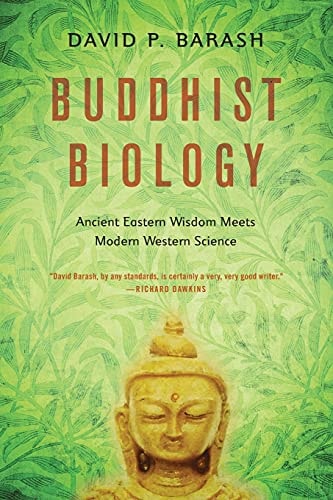
Buddhist Biology: Ancient Eastern Wisdom Meets Modern Western Science
0
0
As an Amazon Associate and affiliate partner, Menrva Books earns from qualifying purchases. Learn more
Author Description
Many high-profile public intellectuals -- including "New Atheists" like Richard Dawkins, Daniel Dennett, and the late Christopher Hitchens -- have argued that religion and science are deeply antagonistic, representing two world views that are utterly incompatible. David Barash, a renowned biologist with forty years of experience, largely agrees with them, but with one very big exception: Buddhism.In this fascinating book, David Barash highlights the intriguing common ground between scientific and religious thought, illuminating the many parallels between biology and Buddhism, allowing readers to see both in a new way. Indeed, he shows that there are numerous places where Buddhist and biological perspectives coincide and reinforce each other. For instance, the cornerstone ecological concept -- the interconnectedness and interdependence of all natural things -- is remarkably similar to the fundamental insight of Buddhism. Indeed, a major Buddhist text, the Avatamsaka Sutra, which consists of ten insights into the "interpenetration" between beings and their environment, could well have been written by a trained ecologist, just as current insights in evolutionary biology, genetics and development might have been authored by the Buddha himself. Barash underscores other notable similarities, including a shared distrust of simple cause-and-effect analysis, an appreciation of the "rightness" of nature, along with an acknowledgment of the suffering that results when natural processes are tampered with. Buddhist Biology shows how the concept of "non-self," so confusing to many Westerners, is fully consistent with modern biology, as is the Buddhist perspective of "impermanence." Barash both demystifies and celebrates the biology of Buddhism and vice versa, showing in a concluding tour-de-force how modern Buddhism --shorn of its hocus-pocus and abracadabra -- not only justifies but actually mandates both socially and environmentally "engaged" thought and practice.
Menrva's Summary
THE THESIS
This book investigates the compatibility between Buddhist philosophy and modern evolutionary biology, challenging the notion that religious and scientific worldviews are inherently antagonistic. David P. Barash, an evolutionary biologist with four decades of academic experience, utilizes his scientific background to bridge the gap between ancient Eastern insights and contemporary biological research. He argues that core Buddhist tenets, such as interconnectedness and impermanence, align closely with ecological and evolutionary principles, suggesting that both disciplines offer complementary frameworks for understanding the natural world.
THE SCOPE MAP
What You Will Find
- Comparative analysis of Buddhist sutras and modern ecological theory
- Examination of the concept of 'non-self' in relation to biological individuality
- Discussion on the ethics of environmental engagement and suffering
Scope Limits
- The text does not provide a comprehensive history of Buddhist theology
- It excludes supernatural or metaphysical aspects of Buddhism to focus strictly on secular, philosophical parallels
THE AUTHORITY PERSPECTIVE
Readers frequently note the accessible yet intellectually rigorous nature of the prose, which successfully avoids overly dense jargon. Experts highlight this work as a significant contribution to the dialogue between secular science and Eastern philosophy, particularly for those interested in the intersection of ethics and evolutionary biology.
Page Count:
218
Publication Date:
2017-08-01
Publisher:
Oxford University Press
ISBN-10:
0190844337
ISBN-13:
9780190844332
Religion
Science
Philosophy of
Buddhism
Biology
Evolutionary Biology
Community Tags
Similar Books