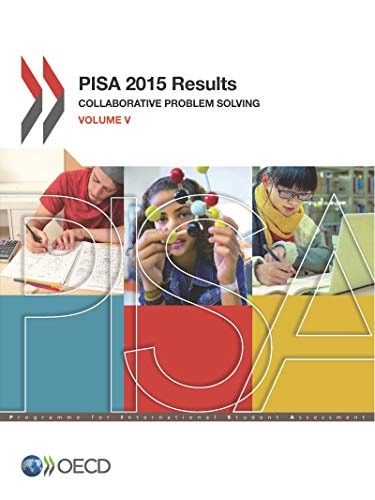
PISA 2015 Results: Collaborative Problem Solving
0
0
As an Amazon Associate and affiliate partner, Menrva Books earns from qualifying purchases. Learn more
Author Description
The OECD Programme for International Student Assessment (PISA) examines not just what students know in science, reading and mathematics, but what they can do with what they know. Results from PISA show educators and policy makers the quality and equity of learning outcomes achieved elsewhere, and allow them to learn from the policies and practices applied in other countries. PISA 2015 Results (Volume V): Collaborative Problem Solving, is one of five volumes that present the results of the PISA 2015 survey, the sixth round of the triennial assessment. It examines students' ability to work with two or more people to try to solve a problem. The volume provides the rationale for assessing this particular skill and describes performance within and across countries. In addition, it highlights the relative strengths and weaknesses of each school system and examines how they are related to individual student characteristics, such as gender, immigrant background and socio-economic status. The volume also explores the role of education in building young people's skills in solving problems collaboratively.
Menrva's Summary
THE THESIS
This report presents the findings of the PISA 2015 survey, focusing on students' collaborative problem-solving abilities. The Organisation for Economic Co-operation & Development (OECD) conducted this triennial assessment to evaluate not only students' knowledge in core subjects but also their capacity to apply that knowledge. Volume V specifically investigates how students perform when working with others to solve problems, analyzing performance across and within various countries. It further explores the relationship between these skills and student characteristics like gender, immigrant background, and socioeconomic status, while also examining education's role in fostering collaborative problem-solving.
THE SCOPE MAP
- Analysis of collaborative problem-solving skills among students worldwide.
- Comparative data on educational performance across participating countries.
- Examination of the impact of student demographics (gender, immigrant background, socio-economic status) on problem-solving abilities.
- Insights into how educational systems foster collaborative skills.
- Methodology and rationale for assessing collaborative problem-solving.
THE AUTHORITY PERSPECTIVE
The PISA 2015 Results (Volume V) provides a detailed analysis of collaborative problem-solving skills, offering valuable data for educators and policymakers. The report's focus on international comparisons allows for benchmarking and the identification of best practices in education systems globally. Its examination of how individual student characteristics relate to performance offers nuanced insights into educational equity. The volume serves as a critical resource for understanding and improving the development of essential 21st-century skills.
Page Count:
300
Publication Date:
2017-12-05
Publisher:
OECD
ISBN-10:
9264285504
ISBN-13:
9789264285507
Science & Technology
Non-Fiction
Education
Statistics
Community Tags
Similar Books