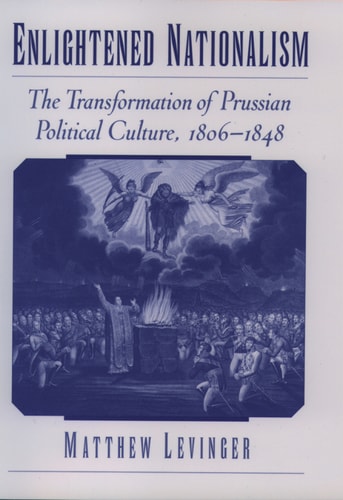
Enlightened Nationalism: The Transformation of Prussian Political Culture, 1806-1848
0
0
As an Amazon Associate and affiliate partner, Menrva Books earns from qualifying purchases. Learn more
Author Description
Enlightened Nationalism provides the first synthesis in English of Prussian political culture from the Napoleonic era to the Revolution of 1848. Matthew Levinger challenges the conventional notion that Prussia lagged behind Western Europe in its political development, demonstrating that Prussian leaders embraced a distinctive program of political modernization in response to their country's defeat by Napoleon in 1806-1807. Building on the eighteenth-century tradition of enlightened absolutism, Prussian leaders attempted to unite a rationalized monarchy with a politically active "nation," thus mobilizing the populace to resist the French oppressors. The new culture of "enlightened nationalism" influenced the political theory and program of both liberals and conservatives in nineteenth-century Prussia. The book has important implications for understanding both subsequent German history and the history of nationalism in general. The author shows that the so-called authoritarian tendencies in Prussia's political culture resulted from its distinctive response to the challenges of the French Revolution and Napoleonic era, rather than from the persistence of premodern cultural or socioeconomic patterns. Likewise, by showing how nationalist activists drew on the cultural legacy of the Enlightenment, Levinger demonstrates that German nationalism cannot be understood as a uniquely pathological political phenomenon. Inspired by recent work exploring the role of discourse in historical change, the book analyzes how the word "nation" functioned in day-to-day debates and how this limited and shaped political options. Enlightened nationalism produced a mixed legacy: it promoted the reform of the education system, popular participation in local self-government, and administrative rationalization. But it also resulted in exaggerated fears of political dissent, reinforcing the authority of the monarchical state and inhibiting the formation of a vibrant system of parliamentary rule.
Menrva's Summary
THE THESIS
This work investigates how the Prussian state navigated the crisis of the Napoleonic era by synthesizing Enlightenment ideals with a burgeoning sense of national identity. Matthew Levinger, a historian specializing in German political culture, utilizes archival research and discourse analysis to argue that Prussian political modernization was a deliberate, rational response to military defeat rather than a byproduct of premodern stagnation. He posits that the resulting 'enlightened nationalism' shaped the trajectory of both liberal and conservative political thought throughout the nineteenth century.
THE SCOPE MAP
What You Will Find
- Analysis of Prussian political discourse between 1806 and 1848.
- Examination of the transition from enlightened absolutism to nationalist mobilization.
- Evaluation of administrative reforms, educational shifts, and local governance structures.
Scope Limits
- The study focuses primarily on the Prussian state and does not provide a comprehensive history of all German-speaking territories.
- The analysis centers on political culture and discourse rather than socioeconomic or military history.
THE AUTHORITY PERSPECTIVE
Historians recognize this text as a significant contribution to the study of German political development, particularly for its focus on the linguistic and cultural construction of the nation. Scholars frequently note that the book provides a nuanced alternative to traditional interpretations of Prussian authoritarianism.
Page Count:
331
Publication Date:
2000-01-01
Publisher:
Oxford University Press
ISBN-10:
0190285109
ISBN-13:
9780190285104
History
Nationalism
Germany history
German history
European History
19th Century
Community Tags
Similar Books