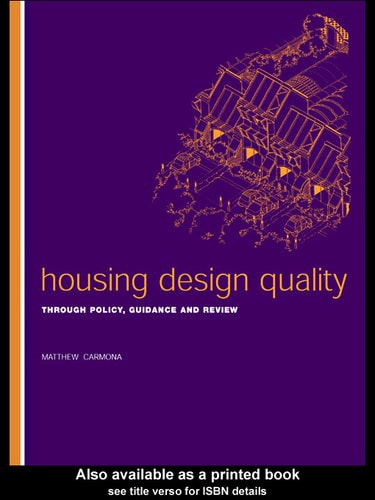
Housing Design Quality
0
0
As an Amazon Associate and affiliate partner, Menrva Books earns from qualifying purchases. Learn more
Author Description
This book directly addresses the major planning debate of our time - the delivery and quality of new housing development. As pressure for new housing development in England increases, a widespread desire to improve the design of the resulting residential environments becomes ever more apparent with increasing condemnation of the standard products of the volume housebuilders.In recent years central government has come to accept the need to deliver higher quality living environments, and the important role of the planning system in helping to raise design standards. Housing Design Quality focuses on this role and in particular on how the various policy instruments available to public authorities can be used in a positive manner to deliver higher quality residential developments.Part one of the book provides the theoretical and policy context for the in-depth research to follow. Debates on housing design and planning control are explored, alongside an in-depth review of government guidance and an exploration of the key theoretical constructs prescribed for effective design control process.Part two constitutes the empirical heart of the work and examines current practice and innovation in the control of residential design. The result of a country-wide survey and content analysis of residential design policy and guidance is next discussed as a means to review mainstream practice and the priorities of planning authorities in attempting to influence residential design quality. A range of innovative experiences in delivering housing design quality through planning action is examined. These are supplemented throughout the book by case studies on which the analysis is based.The final part of the book offers a detailed agenda for delivering housing design quality. It assesses the latest and complimentary policy initiatives from Central Government on residential design and concludes with a look to the future.
Menrva's Summary
THE THESIS
This book investigates how public planning systems can effectively influence and improve the design quality of new residential developments in the face of increasing housing demand. Matthew Carmona, a professor of planning and urban design, utilizes a combination of empirical research, policy analysis, and case studies to evaluate the efficacy of current regulatory instruments. The text argues that while volume housebuilders often prioritize standard products, the planning system possesses the necessary tools to mandate and foster higher standards of living environments through proactive policy intervention.
THE SCOPE MAP
What You Will Find
- A comprehensive review of government guidance and theoretical constructs regarding design control.
- Empirical data derived from a country-wide survey and content analysis of residential design policies.
- Detailed case studies illustrating innovative planning actions and their outcomes in residential projects.
- A strategic agenda for future policy initiatives aimed at elevating housing design standards.
THE AUTHORITY PERSPECTIVE
Experts and urban planning professionals frequently cite this work as a foundational text for understanding the intersection of regulatory policy and residential architecture. Readers often note the academic density of the prose, which provides a rigorous framework for practitioners and policymakers alike.
Page Count:
0
Publication Date:
2004-01-01
Publisher:
Taylor & Francis Group Plc
ISBN-10:
0203187296
ISBN-13:
9780203187296
Architecture
Social Science
Infrastructure
Great Britain
Woningbouw
Logement
urban planning
Nonfiction
Vormgeving
Housing policy
Public Policy
Design
Housing
Community Tags
Other Editions(3)

Similar Books












Reader Comments
Share Your Thoughts
No comments yet. Be the first to share your thoughts!