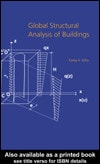
Global Structural Analysis of Buildings
0
0
As an Amazon Associate and affiliate partner, Menrva Books earns from qualifying purchases. Learn more
Author Description
The global structural analysis of buildings can be carried out following two routes. First, sophisticated and complex computer packages based on the finite element method can handle even huge structures with a great number of elements. Second, analytical methods can also deal with whole structures leading to simple closed-form solutions, with the additional benefit of providing fast checking facilities for the computer based methods. This book follows the latter route. As well as describing and solving the complex theoretical problems of bracing systems with real-world examples, the author presents simple procedures and closed-form formulae which make it possible for the practising structural engineer to carry out a general structural analysis of the bracing system of building structures in minutes. Global Structural Analysis of Buildings is a practical reference for professional civil and structural engineers in construction firms, consultancies and building research organisations. The theoretical aspects of the book will appeal to postgraduates, lecturers and researchers of structural analysis and design.
Menrva's Summary
THE THESIS
This book investigates the efficacy of analytical methods and closed-form solutions for the global structural analysis of building bracing systems as an alternative or supplement to complex finite element software. Author K. A. Zalka, an expert in structural mechanics, presents a methodology that prioritizes speed and accessibility for practicing engineers. By focusing on simplified mathematical procedures, the text provides a framework that allows professionals to perform rapid checks on large-scale structural designs. The work bridges the gap between high-level theoretical research and the practical, time-sensitive requirements of modern construction consultancies.
THE SCOPE MAP
What You Will Find
- Analytical methods for the global structural analysis of building bracing systems
- Closed-form formulae for rapid structural verification
- Real-world case studies demonstrating the application of theoretical bracing models
- Comparative analysis between manual analytical procedures and finite element method software
THE AUTHORITY PERSPECTIVE
Experts identify this work as a highly practical resource for structural engineers who require efficient verification tools in a professional setting. Readers frequently note the clarity of the mathematical derivations and the utility of the provided formulae for daily engineering tasks.
Page Count:
341
Publication Date:
2003-01-01
Publisher:
Taylor & Francis Group Plc
ISBN-10:
0203184564
ISBN-13:
9780203184561
Architecture
Construction
Engineering
Structural Engineering
Civil Engineering
Community Tags
Other Editions(2)

Similar Books