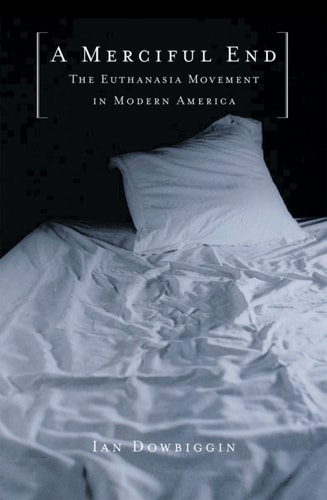
A Merciful End: The Euthanasia Movement in Modern America
0
0
As an Amazon Associate and affiliate partner, Menrva Books earns from qualifying purchases. Learn more
Author Description
While it may seem that debates over euthanasia began with Jack Kervorkian, the practice of mercy killing extends back to Ancient Greece and beyond. In America, the debate has raged for well over a century. Now, in A Merciful End, Ian Dowbiggin offers the first full-scale historical account of one of the most controversial reform movements in America. Drawing on unprecedented access to the archives of the Euthanasia Society of America, interviews with important figures in the movement today, and flashpoint cases such as the tragic fate of Karen Ann Quinlan, Dowbiggin tells the dramatic story of the men and women who struggled throughout the twentieth century to change the nation's attitude--and its laws--regarding mercy killing. In tracing the history of the euthanasia movement, he documents its intersection with other progressive social causes: women's suffrage, birth control, abortion rights, as well as its uneasy pre-WWII alliance with eugenics. Such links brought euthanasia activists into fierce conflict with Judeo-Christian institutions who worried that "the right to die" might become a "duty to die." Indeed, Dowbiggin argues that by joining a sometimes overzealous quest to maximize human freedom with a desire to "improve" society, the euthanasia movement has been dogged by the fear that mercy killing could be extended to persons with disabilities, handicapped newborns, unconscious geriatric patients, lifelong criminals, and even the poor. Justified or not, such fears have stalled the movement, as more and more Americans now prefer better end-of-life care than wholesale changes in euthanasia laws. For anyone trying to decide whether euthanasia offers a humane alternative to prolonged suffering or violates the "sanctity of life," A Merciful End provides fascinating and much-needed historical context.
Menrva's Summary
THE THESIS
This book investigates the historical trajectory of the euthanasia movement in the United States and the ethical, social, and legal tensions that have defined its evolution over the last century. Ian R. Dowbiggin, a historian specializing in the history of medicine and psychiatry, utilizes archival records from the Euthanasia Society of America and contemporary interviews to construct his analysis. He argues that the movement's historical entanglement with eugenics and other progressive social reforms has created persistent public anxiety regarding the potential for abuse, ultimately shaping the current landscape of end-of-life care policy.
THE SCOPE MAP
What You Will Find
- Historical analysis of the Euthanasia Society of America archives
- Examination of the intersection between euthanasia advocacy and eugenics
- Case studies of high-profile legal and ethical flashpoints, including the Karen Ann Quinlan case
- Exploration of the conflict between individual autonomy and institutional religious ethics
Scope Limits
- The text focuses primarily on the American context and does not provide a comprehensive global history of the movement
- It does not serve as a clinical or medical manual for end-of-life care procedures
THE AUTHORITY PERSPECTIVE
Scholars and historians recognize this work as a foundational text for understanding the complex social history of the right-to-die movement in America. Readers frequently note the academic rigor of the research and the author's balanced approach to a highly polarized subject matter.
Page Count:
272
Publication Date:
2003-01-01
Publisher:
Oxford University Press
ISBN-10:
0190288566
ISBN-13:
9780190288563
Non-Fiction
History
Politics
Medical Ethics
Professional Career & Trade
Euthanasia
Medical
Law
Sociology
Allied Health
Community Tags
Similar Books