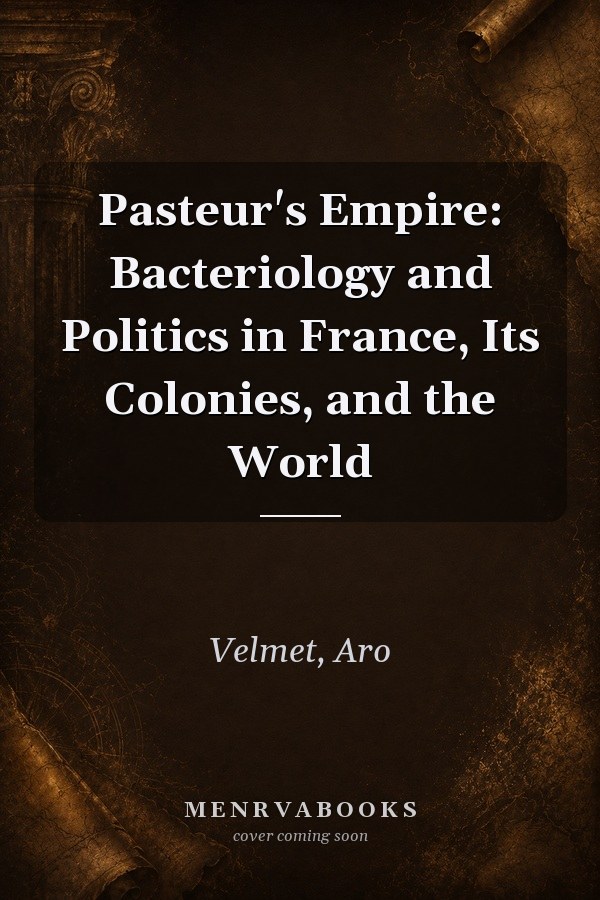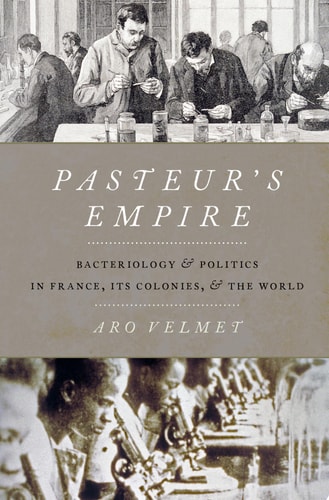
Pasteur's Empire: Bacteriology and Politics in France, Its Colonies, and the World
0
0
As an Amazon Associate and affiliate partner, Menrva Books earns from qualifying purchases. Learn more
Author Description
In the 1890s, the Pasteur Institute established a network of laboratories that stretched across France's empire, from Indochina to West Africa. Quickly, researchers at these laboratories became central to France's colonial project, helping officials monopolize industries, develop public health codes, establish disease containment measures, and arbitrate political conflicts around questions of labor rights, public works, and free association. Pasteur's Empire shows how the scientific prestige of the Pasteur Institute came to depend on its colonial laboratories, and how, conversely, the institutes themselves became central to colonial politics. This book argues that decisions as small as the isolation of a particular yeast or the choice of a laboratory animal could have tremendous consequences on the lives of Vietnamese and African subjects, who became the consumers of new vaccines or industrially fermented intoxicants. Simultaneously, global forces, such as the rise of international standards and American competitors pushed Pastorians to their imperial laboratories, where they could conduct studies that researchers in France considered too difficult or controversial. Chapters follow not just Alexandre Yersin's studies of the plague, Charles Nicolle's public health work in Tunisia, and Jean Laigret's work on yellow fever in Dakar, but also the activities of Vietnamese doctors, African students and politicians, Syrian traders, and Chinese warlords. It argues that a specifically Pastorian understanding of microbiology shaped French colonial politics across the world, allowing French officials to promise hygienic modernity while actually committing to little development. In bringing together global history, imperial history, and science and technology studies, Pasteur's Empire deftly integrates micro and macro analyses into one connected narrative that sheds critical light on a key era in the history of medicine.
Menrva's Summary
THE THESIS
This book investigates how the Pasteur Institute’s global network of laboratories functioned as a critical instrument of French colonial governance and political control. Aro Velmet, a historian of science and empire, utilizes archival research to demonstrate that the scientific authority of the Pasteur Institute was inextricably linked to its colonial outposts. He argues that the application of microbiological expertise in the colonies allowed French officials to project an image of hygienic modernity while simultaneously reinforcing imperial power structures and limiting actual development for local populations.
THE SCOPE MAP
What You Will Find
- Analysis of the Pasteur Institute's expansion into Indochina, West Africa, and Tunisia.
- Examination of the intersection between laboratory research and colonial public health policy.
- Case studies on the development of vaccines, disease containment, and industrial fermentation.
- Perspectives from diverse actors including Vietnamese doctors, African students, and colonial administrators.
Scope Limits
- The study focuses primarily on the French colonial context and does not provide a comprehensive history of global bacteriology outside the Pastorian network.
- The analysis prioritizes the political and social implications of scientific work rather than detailed technical explanations of the biological research itself.
THE AUTHORITY PERSPECTIVE
Scholars in the fields of history of science and imperial studies recognize this work as a significant contribution to understanding the political utility of scientific institutions in colonial settings. Readers frequently note the meticulous archival detail and the author's ability to connect micro-level laboratory decisions to macro-level imperial policy.
Page Count:
322
Publication Date:
2019-01-01
Publisher:
Oxford University Press
ISBN-10:
0190072849
ISBN-13:
9780190072841
History
Medical Books
Modern History
Medical
Technology Studies
Microbiology
Imperialism and science
Medicine
Bacteriology
Philosophy history
French History
New Used & Rental Textbooks
Science & Math
Allied Health
Colonies
World
Medicine history
Colonial History
Earth Sciences
Community Tags
Similar Books