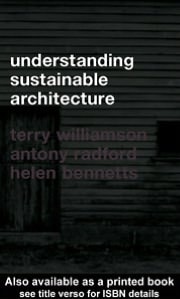
Understanding Sustainable Architecture
0
0
As an Amazon Associate and affiliate partner, Menrva Books earns from qualifying purchases. Learn more
Author Description
Understanding Sustainable Architecture is a review of the assumptions, beliefs, goals and bodies of knowledge that underlie the endeavour to design (more) sustainable buildings and other built developments. Much of the available advice and rhetoric about sustainable architecture begins from positions where important ethical, cultural and conceptual issues are simply assumed. If sustainable architecture is to be a truly meaningful pursuit then it must be grounded in a coherent theoretical framework. This book sets out to provide that framework. Through a series of self-reflective questions for designers, the authors argue the ultimate importance of reasoned argument in ecological, social and built contexts, including clarity in the problem framing and linking this framing to demonstrably effective actions. Sustainable architecture, then, is seen as a revised conceptualisation of architecture in response to a myriad of contemporary concerns about the effects of human activity. The aim of this book is to be transformative by promoting understanding and discussion of commonly ignored assumptions behind the search for a more environmentally sustainable approach to development. It is argued that design decisions must be based on both an ethical position and a coherent understanding of the objectives and systems involved. The actions of individual designers and appropriate broader policy settings both follow from this understanding.
Menrva's Summary
THE THESIS
This book investigates the underlying ethical, cultural, and conceptual assumptions that define the practice of sustainable architecture. The authors, Antony Radford, Helen Bennetts, and Terry Williamson, argue that current sustainable design often lacks a coherent theoretical foundation. By challenging designers to engage in self-reflective questioning, they propose a framework that links clear problem framing to effective, evidence-based ecological and social actions.
THE SCOPE MAP
What You Will Find
- A critical review of existing rhetoric and assumptions in sustainable building practices
- A structured framework for self-reflective design questioning
- Analysis of the intersection between ethical positioning and technical design objectives
- Examination of the relationship between individual design decisions and broader policy settings
THE AUTHORITY PERSPECTIVE
Experts identify this text as a foundational resource for practitioners and students seeking to move beyond superficial sustainability metrics. Readers frequently note the academic density of the prose, which demands a rigorous engagement with the philosophical underpinnings of modern architectural development.
Page Count:
176
Publication Date:
2003-01-01
Publisher:
Taylor & Francis Group
ISBN-10:
0203217292
ISBN-13:
9780203217290
Architecture
Sustainability
urban planning
Ethics
Architecture and society
Community Tags
Similar Books