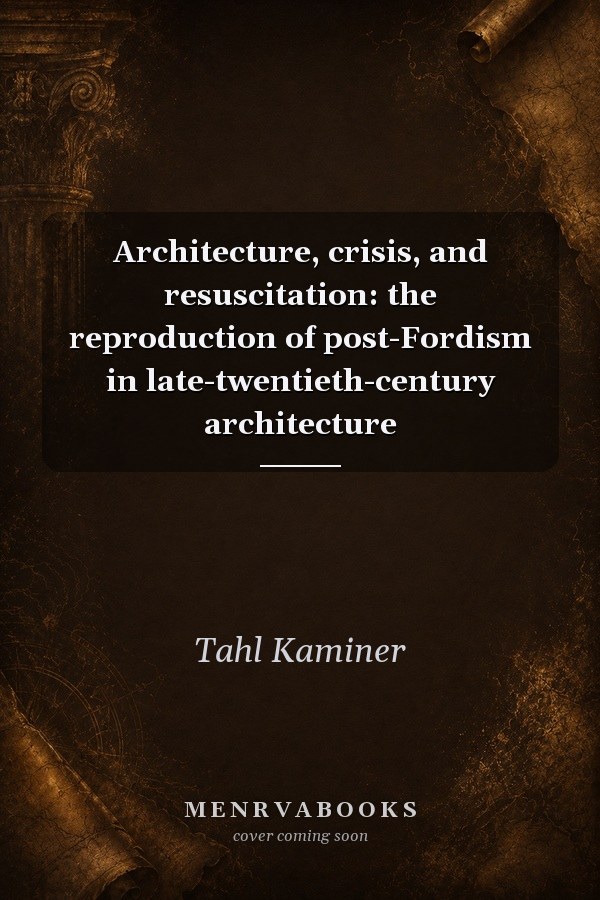
Architecture, Crisis, and Resuscitation: The Reproduction of Post-Fordism in Late-Twentieth-Century Architecture
0
0
As an Amazon Associate and affiliate partner, Menrva Books earns from qualifying purchases. Learn more
Author Description
Studying The Relation Of Architecture To Society, This Book Explains The Manner In Which The Discipline Of Architecture Adjusted Itself In Order To Satisfy New Pressures By Society. Consequently, It Offers An Understanding Of Contemporary Conditions And Phenomena, Ranging From The Ubiquity Of Landmark Buildings To The Celebrity Status Of Architects. It Concerns The Period Spanning From 1966 To The First Years Of The Current Century – A Period Which Saw Radical Change In Economy, Politics, And Culture And A Period In Which Architecture Radically Transformed, Substituting The Alleged Dreariness Of Modernism With Spectacle.
Menrva's Summary
THE THESIS
This book investigates how the architectural discipline adapted its practices and aesthetic output to align with the socio-economic shifts of post-Fordism during the late twentieth century. Tahl Kaminer, an architectural theorist, examines the transition from the perceived austerity of Modernism to the rise of spectacle-driven design. By analyzing the intersection of political economy and built environments, the author argues that architecture functioned as a mechanism for reproducing contemporary capitalist conditions between 1966 and the early 2000s.
THE SCOPE MAP
What You Will Find
- Analysis of the transition from Fordist to post-Fordist economic models in architectural practice.
- Examination of the shift toward spectacle-based design and the rise of the celebrity architect.
- Historical review of architectural discourse and production from 1966 to the early 2000s.
- Critique of how landmark buildings serve as instruments for societal and economic reproduction.
THE AUTHORITY PERSPECTIVE
Scholars and architectural critics recognize this work as a rigorous examination of the structural pressures that shaped contemporary design. Readers frequently note the academic density of the prose, which serves as a foundational text for those studying the intersection of architectural theory and political economy.
Page Count:
202
Publication Date:
2011-01-01
Publisher:
Routledge
ISBN-10:
0203831845
ISBN-13:
9780203831847
History
Architecture
Economics
Architecture and society
Sociology
Urban Studies