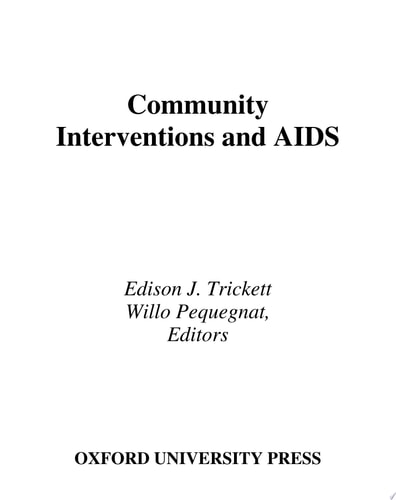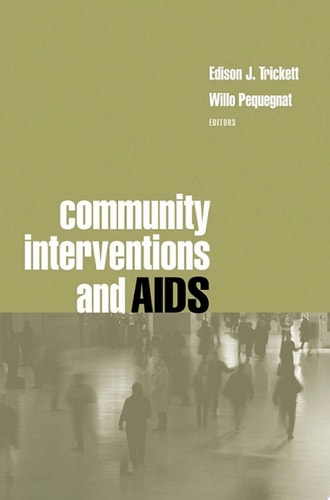
Community Interventions and AIDS
0
0
As an Amazon Associate and affiliate partner, Menrva Books earns from qualifying purchases. Learn more
Author Description
As news headlines report staggering numbers of people infected with HIV or AIDS across the globe and as stereotypes of typical AIDS patients become less and less specific to particular sexual orientations and ethnic backgrounds, the AIDS pandemic shows little sign of relenting. AIDS crosses geopolitical and social barriers, and social and behavioral scientists are confronted with the new challenge of developing scientific inquiry and corresponding interventions around participatory, community-based, and community-focused methods. These interventions are increasingly targeting the contextual influences on individual behavior, such as peer groups, social networks and support systems, and community norms. Community-level interventions also draw on local resources and are respectful of sociocultural circumstances and traditions. This book articulates how the social and behavioral sciences can respond to HIV/AIDS. It is written for all who have a stake in AIDS research, stimulating discussion and debate about the natures of community research and intervention broadly across such disciplines as public health, community health education, urban planning, psychology, sociology, anthropology, and philosophy of science. The book proposes alternative perspectives on means of ascertaining knowledge about the HIV/AIDS pandemic and the inclusion of community collaboration in interventions.
Menrva's Summary
THE THESIS
This volume investigates how social and behavioral sciences can effectively address the HIV/AIDS pandemic through participatory, community-based intervention strategies. Editors Edison J. Trickett and Willo Pequegnat synthesize contributions from diverse academic fields to argue that individual behavior must be understood within the context of peer groups, social networks, and community norms. The text advocates for research methodologies that prioritize local resources and respect sociocultural traditions to create sustainable health outcomes.
THE SCOPE MAP
What You Will Find
- Frameworks for community-focused HIV/AIDS intervention research
- Analysis of contextual influences on individual health behaviors
- Methodologies for integrating community collaboration into public health initiatives
Scope Limits
- Does not provide clinical medical protocols for HIV treatment
- Does not focus on individual-level psychotherapy techniques
THE AUTHORITY PERSPECTIVE
Experts recognize this work as a foundational text for understanding the shift toward community-based models in public health research. Readers frequently note the academic density of the prose, which serves as a comprehensive resource for professionals in sociology, anthropology, and urban planning.
Page Count:
308
Publication Date:
2005-01-01
Publisher:
Oxford University Press
ISBN-10:
0190289562
ISBN-13:
9780190289560
Psychology
Community Health
Medical
Social Science
Allied Health
Public Health
Hiv AIDS
Sociology