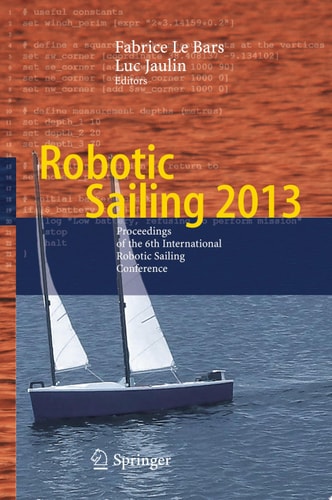
Robotic Sailing 2013
0
0
As an Amazon Associate and affiliate partner, Menrva Books earns from qualifying purchases. Learn more
Author Description
An autonomous sailboat robot is a boat that only uses the wind on its sail as propelling force, without remote control or human assistance to achieve its mission. This involves autonomy in energy (using batteries, solar panels, turbines...), sensor data processing (compass, GPS, wind sensor...), actuators control (rudder and sail angle control...) and decision making (embedded computer with adequate algorithms). Although robotic sailing is a relatively new field of research, several applications exist for this type of robots: oceanographic and hydrographic research, maritime environment monitoring, meteorology, harbor safety, assistance and rescue in dangerous areas... Over the last decade, several events such as the Microtransat challenge, the WRSC/IRSC and SailBot have been set up to stimulate research and development around robotic sailing. These proceedings cover the current and future academic and technology challenges raised by the development of autonomous sailboat robots presented at the WRSC/IRSC (World Robotic Sailing Championship/International Robotic Sailing Conference) 2013, in Brest, France, 2-6 September 2013.
Menrva's Summary
THE THESIS
This book explores the challenges and advancements in autonomous sailboat robots, which navigate solely by wind power without human intervention. The proceedings from the WRSC/IRSC 2013 conference detail the academic and technological hurdles in developing these robots, covering aspects like energy autonomy, sensor data processing, actuator control, and decision-making algorithms. The research presented addresses applications in oceanographic research, environmental monitoring, meteorology, and maritime safety, reflecting the growing interest and development in this specialized field.
THE SCOPE MAP
- Technical papers and research findings from the World Robotic Sailing Championship/International Robotic Sailing Conference 2013.
- Discussions on energy autonomy for robotic sailboats (batteries, solar panels, turbines).
- Analysis of sensor data processing (compass, GPS, wind sensors).
- Examination of actuator control systems (rudder and sail angle).
- Exploration of decision-making algorithms for autonomous navigation.
- Applications of robotic sailing in research, monitoring, and safety.
- Insights into current and future academic and technology challenges in the field.
THE AUTHORITY PERSPECTIVE
The collected papers from the WRSC/IRSC 2013 conference offer a snapshot of the state of the art in robotic sailing research. The focus on technical challenges and academic advancements suggests a readership of engineers, researchers, and students in robotics and marine technology. The proceedings likely provide detailed technical insights into the development of autonomous systems for marine environments.
Page Count:
149
Publication Date:
2013-08-15
Publisher:
Springer Nature
ISBN-10:
3319022768
ISBN-13:
9783319022765
Science & Technology
Non-Fiction
Engineering
Robotics
Research
Community Tags
Similar Books