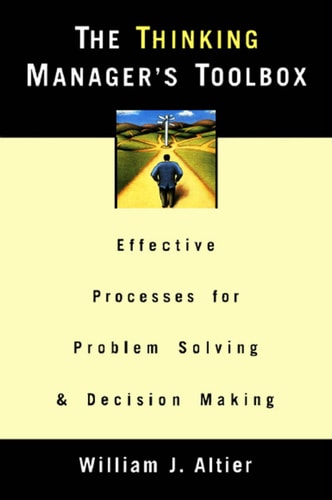
The Thinking Manager's Toolbox: Effective Processes for Problem Solving and Decision Making
0
0
As an Amazon Associate and affiliate partner, Menrva Books earns from qualifying purchases. Learn more
Author Description
In this indispensable book, a widely experienced business consultant provides a complete set of analytical tools essential to successful trouble-shooting, effective planning, and making better decisions faster, more confidently, and more often. How can you help your company solve a problem in just a few days that's been plaguing managers for three months? How can you bring a room of executives to a consensus on a critical decision that the CEO and his committee have been wrestling with for years? Of course, this is easier said than done. Indeed, not a week goes by without a major business media story about a company that has fallen on hard times and an executive that has resigned for "personal reasons." The root of the failure is usually ineffective decision-making processes, and ultimately, bad decisions. In The Thinking Manager's Toolbox, veteran consultant and renowned business thinker William J. Altier cogently presents the underpinnings of successful thinking processes and their applications, drawing on practical, real-world experiences. The first section explores the fundamentals of thinking, change, and the critical role that sound thinking processes play in effective problem solving. The second section, your basic toolbox, develops five, in-depth fundamental thinking processes. And a third section, the advanced toolbox, develops more specialized applications for creative problem solving. Here then is a valuable primer for anyone, whether a middle manager or a CEO, seeking to solve problems and make better decisions more efficiently. The Thinking Manager's Toolbox is an invaluable resource for those seeking to develop the fundamental thinking processes necessary to perform with excellence.
Menrva's Summary
THE THESIS
This book investigates how structured analytical thinking processes can be systematically applied to resolve complex business problems and improve executive decision-making speed and accuracy. William J. Altier, a veteran business consultant, draws upon decades of practical experience to argue that organizational failure often stems from flawed cognitive processes rather than a lack of effort. He presents a structured framework designed to transition managers from intuitive, often erratic decision-making to a disciplined, repeatable methodology. The text serves as a manual for identifying root causes and achieving consensus in high-stakes corporate environments.
THE SCOPE MAP
What You Will Find
- Five fundamental thinking processes for daily management tasks
- Specialized applications for creative problem solving and troubleshooting
- Methodologies for achieving executive consensus on long-standing issues
Scope Limits
- The text does not cover interpersonal soft skills or emotional intelligence training
- It does not address industry-specific technical requirements or financial modeling software
THE AUTHORITY PERSPECTIVE
Readers frequently note the practical, procedural density of the prose, which prioritizes actionable frameworks over theoretical abstraction. Experts highlight this as a foundational text for managers seeking to standardize their approach to organizational challenges.
Page Count:
233
Publication Date:
1999-01-01
Publisher:
Oxford University Press
ISBN-10:
0190285125
ISBN-13:
9780190285128
Business
Principles of Management
Management
Decision Making
Leadership
Professional Development
Special Topics
Community Tags
Similar Books