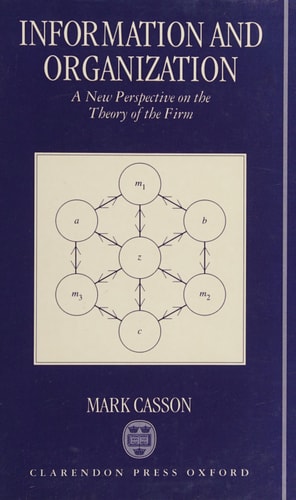
Information and Organization: A New Perspective on the Theory of the Firm
0
0
As an Amazon Associate and affiliate partner, Menrva Books earns from qualifying purchases. Learn more
Author Description
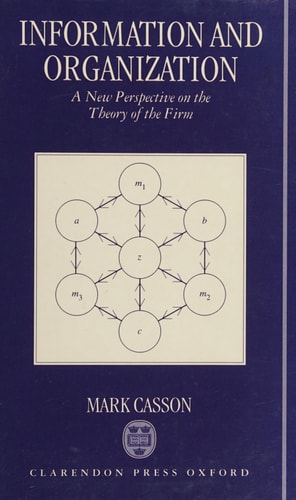
This book offers a vision of the economy as a system of structured information flow. The structuring is effected by institutions, and in particular by firms, which specialize in processing the information needed to allocate resources properly. Firms are the institutional embodiment of the visions of individual entrepreneurs who believe that they have found a better way of allocating resources. Entrepreneurial vision is only a partial vision, however, in the sense that it does not encompass the entire economy, but only a subset of it. Free market economies encourage the exploitation of such partial visions because they encourage intermediation-it is by mediating between potential buyers and potential sellers that entrepreneurial visions are realized. A legal framework of private property, coupled with a moral framework to control the incidence of cheating, allows very sophisticated structures of information processing to emerge. These structures effect an elaborate division of labour in the dimensions of information and control. Each firm is a small component of the overall structure of information flow. This structure is highly flexible and evolves continuously as circumstances change. Efficient adaptation is encouraged by rewarding entrepreneurs who create new firms to be slotted into the existing structure. This vision has evolved over the last fifteen years, during which the author has researched a variety of topics connected with the theory of the firm-entrepreneurship, business culture, multinational enterprise, joint ventures and the like. In each of these areas he has identified the ways in which the orthodox theory of the firm needs to be modified in order to make it work properly. This book represents a major intellectual synthesis of that work.
Menrva's Summary
THE THESIS
How do firms function as specialized institutions for processing information to optimize resource allocation within a market economy? Mark Casson, a noted economist, synthesizes fifteen years of research into entrepreneurship, multinational enterprises, and business culture to propose a revised theory of the firm. He argues that firms emerge as institutional embodiments of entrepreneurial vision, acting as flexible nodes within a broader, evolving structure of information flow and control.
THE SCOPE MAP
What You Will Find
- Analysis of the firm as an information-processing institution rather than a mere production unit.
- Examination of the role of private property and moral frameworks in mitigating opportunistic behavior.
- Theoretical framework for understanding the division of labor in terms of information and control.
- Synthesis of research on entrepreneurship, joint ventures, and multinational enterprise dynamics.
THE AUTHORITY PERSPECTIVE
Economists and business scholars recognize this work as a significant contribution to the evolution of institutional economics. Readers frequently note the academic density of the prose, which serves as a foundational text for those studying the structural mechanics of modern business organizations.
Page Count:
336
Publication Date:
2003-12-04
Publisher:
Oxford University Press
ISBN-10:
0198297807
ISBN-13:
9780198297802
Economics
Business
Management
Decision Making
Information Management
Economic Theory
Community Tags
Other Editions(3)

Similar Books









Reader Comments
Share Your Thoughts
No comments yet. Be the first to share your thoughts!