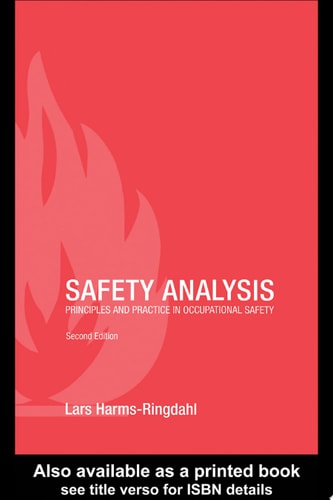
Safety Analysis
0
0
As an Amazon Associate and affiliate partner, Menrva Books earns from qualifying purchases. Learn more
Author Description
Safety analysis can be applied as a practical tool in occupational safety. It has three main elements: the identification of hazards, the assessment of risks that arise, and the generation of measures to increase the level of safety. A number of simple methods are described that can be used in industry and the workplace, such as deviation analysis, energy analysis and job safety analysis, which address risks in ordinary workplaces. For special cases, more technically oriented methods are presented, such as fault tree analysis, event tree analysis, and HAZOP. The book describes a number of other methods and compares their features. These methods are set out in a step by step manner and practical advise is given on how to perform an analysis. Cost-benefit considerations and other useful background information, such as types of results which can be obtained, are also given.
Menrva's Summary
THE THESIS
This book investigates the practical application of safety analysis as a systematic tool for identifying hazards, assessing risks, and implementing safety measures within industrial and workplace environments. Lars Harms-Ringdahl provides a structured framework for safety professionals to evaluate operational risks using both simple and technically complex methodologies. By integrating theoretical background with step-by-step procedural guidance, the author establishes a comprehensive approach to improving workplace safety standards.
THE SCOPE MAP
What You Will Find
- Practical methodologies including deviation analysis, energy analysis, and job safety analysis.
- Advanced technical assessment techniques such as fault tree analysis, event tree analysis, and HAZOP.
- Comparative analysis of various safety assessment features and their specific application contexts.
- Guidance on cost-benefit considerations and the interpretation of analytical results.
THE AUTHORITY PERSPECTIVE
Experts recognize this work as a practical manual for safety practitioners seeking to standardize their risk assessment processes. Readers frequently note the clarity of the step-by-step instructions, making it a useful reference for both general workplace safety and specialized technical analysis.
Page Count:
302
Publication Date:
2001-01-01
Publisher:
Taylor & Francis, Inc.
ISBN-10:
0203302737
ISBN-13:
9780203302736
Safety & Health
Safety Engineering
Technical Reference
Occupational Health