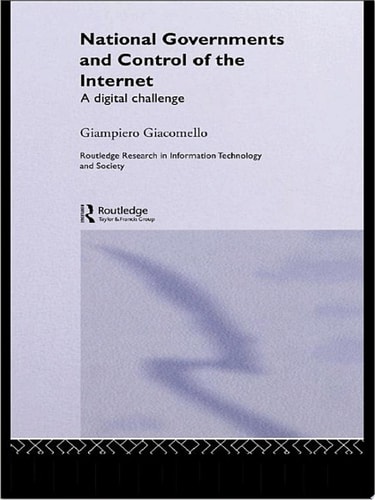
National Governments and Control of the Internet
0
0
As an Amazon Associate and affiliate partner, Menrva Books earns from qualifying purchases. Learn more
Author Description
In recent years, Internet control has become one of the major indicators to assess the balance between freedom and security in democracies. This book explores and compares why, and to what extent, national governments decide to control the Internet and how this impacts on crucial socio-economic activities and fundamental civil rights. The author provides detailed studies on the US, Germany, Italy and further case studies on Brazil, Canada, India, the Netherlands, South Africa and Switzerland, to address topics such national security, freedom of expression and privacy.
Menrva's Summary
THE THESIS
This book investigates the motivations and mechanisms behind national government efforts to regulate and control the Internet within democratic frameworks. Giampiero Giacomello, an expert in international relations and technology policy, examines the tension between state security requirements and the protection of civil liberties. By analyzing a diverse range of national approaches, the author constructs a comparative framework to understand how different political systems navigate the challenges of digital governance and socio-economic oversight.
THE SCOPE MAP
What You Will Find
- Comparative analysis of Internet control policies across eight distinct nations including the US, Germany, and Brazil.
- Examination of the intersection between national security mandates and individual privacy rights.
- Case studies detailing the impact of digital regulation on freedom of expression and economic activity.
- A structured methodology for assessing the balance of power between state authority and digital autonomy.
THE AUTHORITY PERSPECTIVE
Experts identify this work as a significant contribution to the study of digital sovereignty and comparative political science. Readers frequently note the academic rigor and the clarity with which the author navigates complex legal and technological landscapes.
Page Count:
0
Publication Date:
2005-01-01
Publisher:
Taylor & Francis, Inc.
ISBN-10:
0203329856
ISBN-13:
9780203329856
Law
Technology
Sociology
International relations
Community Tags
Other Editions(3)

Similar Books