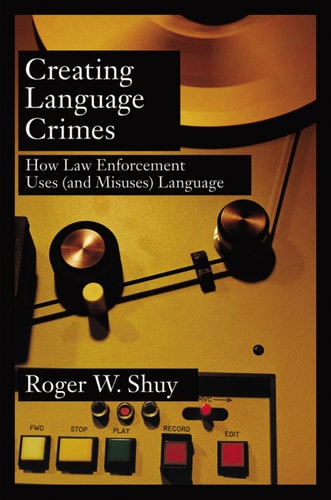
Creating Language Crimes: How Law Enforcement Uses (and Misuses) Language
0
0
As an Amazon Associate and affiliate partner, Menrva Books earns from qualifying purchases. Learn more
Author Description
This book by Roger W. Shuy, the senior figure in forensic linguistics, is the first to explain in an accessible way the vital role that linguistic evidence and its proper analysis play in criminal investigations.Shuy provides compelling case studies of how language functions in investigations involving, among others, wired undercover operatives, and the interrogation of suspects. He makes the point that language evidence can be as important as physical evidence, but yet does not enjoy the same degree of scrutiny by investigators, attorneys, and the courts. Beyond this, however, his more controversial thesis is that police frequently misuse or manipulate language, using various powerful controversial strategies, in order to intentionally create an impression of the targets' guilt or even to get them to confess.This book makes its case by analyzing a dozen criminal cases involving a variety of crimes, such as fraud, bribery, stolen property, murder, and others. About half involve co-operating witnesses who do the tape recording, and the other half undercover police officers. These cases demonstrate how undercover operatives use different conversational strategies, such as overlapping conversation, ambiguity, interruption, refusing to take "no" for an answer, and others to create a negative impression of the targets on later listeners.Creating Language Crimes provides a fascinating window into a little-known and discussed facet of law enforcement. It will appeal to anyone concerned with language (particularly sociolinguists and discourse analysts), as well as to those involved in law enforcement and criminal cases.
Menrva's Summary
THE THESIS
This book investigates the critical role of linguistic evidence in criminal investigations and argues that law enforcement frequently manipulates conversational strategies to manufacture the appearance of guilt. Roger W. Shuy, a senior figure in the field of forensic linguistics, utilizes his extensive academic background to analyze how language is used during interrogations and undercover operations. He posits that linguistic evidence requires the same level of rigorous scrutiny as physical evidence, yet it is often subject to misuse by authorities to secure confessions or influence judicial outcomes.
THE SCOPE MAP
What You Will Find
- Analysis of a dozen criminal cases including fraud, bribery, and murder
- Examination of conversational tactics such as overlapping speech, ambiguity, and interruption
- Evaluation of the role of undercover operatives and cooperating witnesses in recording evidence
Scope Limits
- The text focuses primarily on American law enforcement practices
- It does not provide a comprehensive legal manual for defense attorneys
THE AUTHORITY PERSPECTIVE
Experts recognize this work as a foundational text in the field of forensic linguistics, noting its accessibility for both academics and legal professionals. Readers frequently highlight the clarity of the case studies, which effectively demonstrate the practical application of discourse analysis in high-stakes criminal environments.
Page Count:
209
Publication Date:
2005-01-01
Publisher:
Oxford University Press
ISBN-10:
0190292806
ISBN-13:
9780190292805
Non-Fiction
Linguistics
Forensic Science
Professional Career & Trade
English
English & College Success
Law Courts
Criminology
Law Enforcement
Community Tags
Similar Books