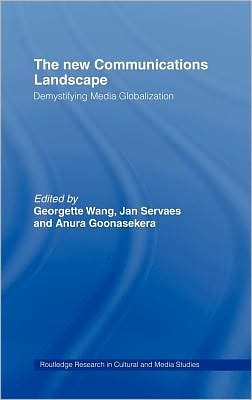
New Communications Landscape
0
0
As an Amazon Associate and affiliate partner, Menrva Books earns from qualifying purchases. Learn more
Author Description
The innovative and rapid growth of communication satellites and computer mediated technologies in the late 1980s and early 1990s, combined with the deregulation of national broadcasting, led many media commentators to assume that the age of national media had been lost. But what has become clear is that, whilst there has been a limited growth in global media, there has been an emergence of a strong localised television and communications industry. Mapping the world media market, and using examples of programming from countries as diverse as Thailand, Hong Kong, Brazil, Taiwan, Spain and Britain, this volume explores theories of media globalization, examines the local culture of television programming and analyses the blurring of distinctions between the global and the local.
Menrva's Summary
THE THESIS
This volume investigates the tension between global media expansion and the simultaneous rise of localized television industries in the late 20th century. Edited by Anura Goonasekera, Georgette Wang, and Jan Servaes, the text synthesizes contributions from various media scholars to challenge the assumption that national media systems were rendered obsolete by satellite and computer-mediated technologies. The authors utilize a comparative framework to argue that global and local media forces are increasingly intertwined rather than mutually exclusive.
THE SCOPE MAP
What You Will Find
- Analysis of media globalization theories in the context of the late 1980s and early 1990s.
- Comparative case studies of television programming in Thailand, Hong Kong, Brazil, Taiwan, Spain, and Britain.
- Examination of the impact of broadcasting deregulation on national media markets.
- Theoretical exploration of the blurring distinctions between global media reach and local cultural production.
THE AUTHORITY PERSPECTIVE
Experts recognize this volume as a significant contribution to the study of media localization during the early era of digital and satellite expansion. Scholars frequently cite the text for its diverse geographical focus and its nuanced critique of early globalization theories.
Page Count:
0
Publication Date:
2000-01-01
Publisher:
Routledge
ISBN-10:
0203361180
ISBN-13:
9780203361184
Communication Studies
Sociology
Media Studies
Globalization
Community Tags
Similar Books