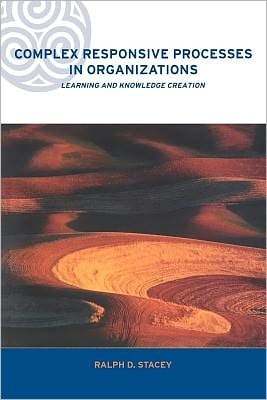
Complex Responsive Processes in Organizations: Learning and Knowledge Creation
0
0
As an Amazon Associate and affiliate partner, Menrva Books earns from qualifying purchases. Learn more
Author Description
The past decade has seen increasing focus on the importance of information and knowledge in economic and social processes, the so-called 'knowledge economy'. This is reflected in the popularity amongst practicing managers and organizational theorists of notions of learning, sense-making, knowledge creation, knowledge management and intellectual capital in organizations and more recently, of emotional intelligence as an important management skill. This insightful book: argues that the information processing view of knowledge creation held by systems thinkers is no longer tenable develops the alternative perspective of Complex Responsive Processes of relating, drawing on the complexity sciences as a source for analogies with human action places self-organizing interaction at the centre of the knowledge creating process in organizations. Learning and knowledge creation are seen as qualitative processes of power relating that are emotional as well as intellectual, creative as well as destructive, enabling as well as constraining, and the result is a radical questioning of the belief that organizational knowledge is essentially codified and centralized. Instead, organizational knowledge is understood to be in the relationships between people in an organization and has to do with the qualities of those relationships.
Menrva's Summary
THE THESIS
This book investigates the limitations of traditional information-processing models in organizational theory and proposes an alternative framework based on complex responsive processes. Ralph Stacey, a prominent organizational theorist, utilizes insights from the complexity sciences to challenge the prevailing view that knowledge is a static, centralized asset. He argues that organizational learning is fundamentally a social, emotional, and relational phenomenon that emerges from the ongoing interactions between people rather than through formal systems.
THE SCOPE MAP
What You Will Find
- A critique of systems thinking and information-processing models in management.
- An application of complexity science analogies to human social action.
- A framework for understanding knowledge creation as a qualitative process of power relating.
- An analysis of how emotional and intellectual dynamics shape organizational outcomes.
THE AUTHORITY PERSPECTIVE
Experts in organizational development recognize this text as a foundational challenge to mainstream management theory. Readers frequently note the academic density of the prose, which requires a significant commitment to understanding the philosophical underpinnings of complexity science.
Page Count:
0
Publication Date:
2003-01-01
Publisher:
Taylor & Francis Group
ISBN-10:
0203361482
ISBN-13:
9780203361481
Business
Complexity Science
Organizational effectiveness
Management
Organizational Theory
Community Tags
Similar Books