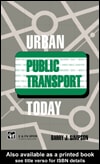
Urban Public Transport Today
0
0
As an Amazon Associate and affiliate partner, Menrva Books earns from qualifying purchases. Learn more
Author Description
It is widely recognised that there are many people for whom public transport is essential, particularly amongst the elderly, children and teenagers. Less obvious is the dependence of our cities for their existence on high capacity public transport. Although there is still a prevalent view that local public transport is only for those who do not have a car, we are slowly beginning to realise that we need to find ways of restricting use of the private car more severely and that will involve some transfer to public transport. There is a widening gap between what we expect of public transport and what can be delivered. Our expectations for travel are increasing, both in quantity and in the standards of speed, reliability and comfort. Out-of-town shopping, leisure parks and business parks all involve more travel than did their predecessors. Cars are becoming more like mobile sitting rooms with all the home comforts such as CD player and telephone. To give all this up for a bus or train is asking a lot. Urban Public Transport Today gives an honest appraisal of the pros and cons of new public transport technologies. It shows how public transport can be made a less unacceptable alternative to the private car than it is now. Public transport needs to be co-ordinated and planned together with land uses under the Town and Country Planning legislation; too often public transport solutions overlook the significance of town planning policies generating demand for travel. The author draws on a thorough study of many continental European countries and includes the latest Euro-legislation and recent case histories to give a comprehensive coverage of everything from policy problems (including land use decisions) to practical considerations (including road building). Urban Public Transport Today will be invaluable for all those involved in the land use/local transport conundrum, including planning officers, policy makers and transport consultants as well as students in transport studies.
Menrva's Summary
THE THESIS
This book investigates the widening gap between public expectations for urban mobility and the current capacity of public transport systems to meet those demands. Barry J. Simpson, an expert in transport studies, utilizes a comparative analysis of continental European models and recent legislative frameworks to argue that effective transit solutions require the integration of land-use planning with transport policy. The text posits that shifting reliance away from private vehicles necessitates a fundamental reassessment of how urban environments are designed and managed.
THE SCOPE MAP
What You Will Find
- Comparative analysis of public transport systems across multiple European countries.
- Examination of the intersection between Town and Country Planning legislation and transit demand.
- Case histories detailing the successes and failures of various transport technologies.
- Practical frameworks for coordinating land use decisions with road building and infrastructure development.
THE AUTHORITY PERSPECTIVE
Experts identify this work as a foundational text for professionals navigating the complexities of urban mobility and land-use policy. Readers frequently note the technical density of the prose, which provides a comprehensive resource for planning officers, policy makers, and students in the field.
Page Count:
222
Publication Date:
2004-01-01
Publisher:
Taylor & Francis Group Plc
ISBN-10:
0203374819
ISBN-13:
9780203374818
Transportation And State
urban planning
Civil Engineering
Urban policy
Transportation
Public Transportation
Bus lines
Railroads
Geography
Planning
Public Policy
Nonfiction
Community Tags
Other Editions(3)


Similar Books



Reader Comments
Share Your Thoughts
No comments yet. Be the first to share your thoughts!