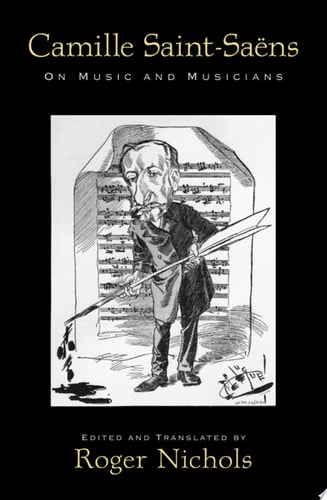
Saint-Saëns: On Music and Musicians
0
0
As an Amazon Associate and affiliate partner, Menrva Books earns from qualifying purchases. Learn more
Author Description
Camille Saint-Saëns is a memorable figure not only for his successes as a composer of choral and orchestral works, and the eternally popular opera Samson et Dalila, but also because he was a keen observer of the musical culture in which he lived. A composer of vast intelligence and erudition, Saint-Saëns was at the same time one of the foremost writers on music in his day. From Wagner, Liszt and Debussy to Milhaud and Stravinsky, Saint-Saëns was at the center of the elite musical and cultural fin de siècle and early 20th Century world. He championed Schumann and Wagner in France at a period when these composers were regarded as dangerous subversives whose music should be kept well away from the impressionable student. Yet Saint-Saëns himself had no aspirations to being a revolutionary, and his appreciation of Wagner the composer was tempered by his reservations over Wagner the philosopher and dramatist, suspicious as he was of what he called "the Germanic preoccupation with going beyond reality." Whether defending Meyerbeer against charges of facility or Berlioz against those who questioned his harmonic grasp, Saint-Saëns was always his own man: in both cases, he claimed, it was "not the absence of faults but the presence of virtues" that distinguishes the good composer.Saint-Saëns's writings provide a well-argued counter-discourse to the strong modernist music critics who rallied around Debussy and Ravel during the fin de siècle. And above all, they demonstrate a brilliantly sharp and active brain, expressing itself through prose of a Classical purity and balance, enlivened throughout with flashes of wit and, at times, of sheer malice.In this generously annotated volume, renowned scholar, seasoned translator and radio broadcaster Roger Nichols brings some of the composer's most striking and evocative writings brilliantly to life in English translation, many for the first time. Nichols has carefully chosen these selections for their intrinsic interest as historical
Menrva's Summary
THE THESIS
This volume investigates the critical perspective and intellectual contributions of Camille Saint-Saëns as a writer on music and culture during the fin de siècle and early 20th century. Roger Nichols, a noted scholar and translator, compiles and annotates a selection of Saint-Saëns's essays to illustrate his role as a central figure in French musical life. The text argues that Saint-Saëns served as a vital counter-discourse to the modernist critics of his era, revealing a composer whose prose was as precise and balanced as his musical compositions.
THE SCOPE MAP
What You Will Find
- A curated collection of essays and writings by Camille Saint-Saëns translated into English.
- Commentary on major figures including Wagner, Liszt, Debussy, Milhaud, and Stravinsky.
- Analysis of Saint-Saëns's aesthetic philosophy regarding composers like Meyerbeer and Berlioz.
Scope Limits
- The book does not provide a comprehensive biography of the composer's life.
- It does not offer an exhaustive technical analysis of his musical scores.
THE AUTHORITY PERSPECTIVE
Experts recognize this volume as a significant contribution to the study of French musical history, particularly for its translation of previously inaccessible primary source material. Readers frequently note the clarity of Nichols's annotations and the sharpness of Saint-Saëns's prose, which provides a unique window into the cultural debates of the period.
Page Count:
199
Publication Date:
2008-01-01
Publisher:
Oxford University Press
ISBN-10:
0190295643
ISBN-13:
9780190295646
Biography
Music Criticism
Music History
Essays
Humanities
Community Tags
Similar Books