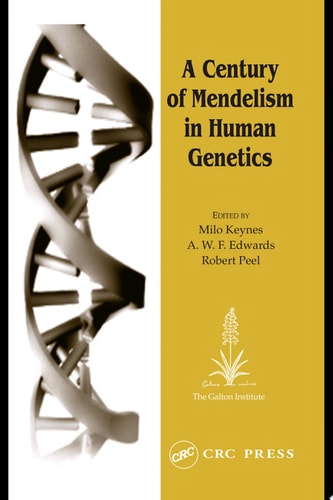
A Century of Mendelism in Human Genetics
0
0
As an Amazon Associate and affiliate partner, Menrva Books earns from qualifying purchases. Learn more
Author Description
In 1901 William Bateson, Professor of Biology at Cambridge, published a renewed version of a lecture which he had delivered the year before to the Royal Horticultural Society in London (reprinted in the book as an appendix). In this lecture he recognized the importance of the work completed by Gregor Mendel in 1865, and brought it to the notice of the scientific world. Upon reading Bateson's paper, Archibald Garrod realized the relevance of Mendel's laws to human disease and in 1902 introduced Mendelism to medical genetics. The first part of A Century of Mendelism in Human Genetics takes a historical perspective of the first 50 years of Mendelism, including the bitter argument between the Mendelians and the biometricians. The second part discusses human genetics since 1950, ending with a final chapter examining genetics and the future of medicine. The book considers the genetics of both single-gene and complex diseases, human cancer genetics, genetic linkage, and natural selection in human populations. Besides being of general medical significance, this book will be of particular interest to departments of genetics and of medical genetics, as well as to historians of science and medicine.
Menrva's Summary
THE THESIS
This book investigates the historical trajectory and medical application of Mendelian genetics over the course of a century. Author W. Milo Keynes, drawing on his expertise in medical history, examines the transition of Gregor Mendel's principles from botanical theory to a foundational pillar of human clinical genetics. The text provides a structured analysis of how these laws were integrated into medical practice, starting with the early 20th-century synthesis by Archibald Garrod and extending into modern genomic medicine.
THE SCOPE MAP
What You Will Find
- Historical analysis of the conflict between Mendelians and biometricians in the early 20th century.
- Examination of the application of genetic laws to single-gene and complex human diseases.
- Overview of developments in human cancer genetics and genetic linkage studies.
- Discussion on the role of natural selection in human populations and the future of medical genetics.
THE AUTHORITY PERSPECTIVE
Experts and historians of science recognize this work as a comprehensive record of the evolution of medical genetics. Readers frequently note the academic density of the prose, which serves as a valuable reference for both medical professionals and scholars of scientific history.
Page Count:
176
Publication Date:
2004-03-15
Publisher:
CRC Press Inc
ISBN-10:
0203392159
ISBN-13:
9780203392157
Science
Mendels Law
Genetics
Medicine
Biology
Human Genetics
Community Tags
Similar Books