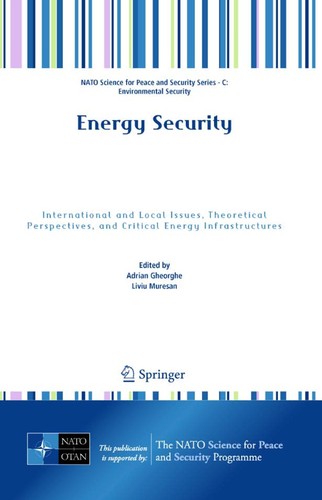
Energy Security
0
0
As an Amazon Associate and affiliate partner, Menrva Books earns from qualifying purchases. Learn more
Author Description
Energy security has become a top priority issue for the United States and countries around the globe, but what does the term "energy security" really mean? For many it is assuring the safe supply and transport of energy as a matter of national security. For others it is developing and moving toward sustainable and low-carbon energy sources to avoid environmental catastrophe, while still others prioritize affordability and abundance of supply. The demand for energy has ramifications in every part of the globe—from growing demand in Asia, to the pursuit of reserves in Latin America and Africa, to the increased clout of energy-producing states such as Russia and Iran. Yet the fact remains that the vast majority of global energy production still comes from fossil fuels, and it will take a thorough understanding of the interrelationships of complex challenges—finite supply, environmental concerns, political and religious conflict, and economic volatility—to develop policies that will lead to true energy security. In Energy Security, Brookings scholars present a realistic, cross-disciplinary look at the American and global quests for energy security within the context of these geopolitical, economic, and environmental challenges. For example, political analysts Pietro Nivola and Erin Carter wrap their arms around just what is means to be "energy independent" and whether that is an advisable or even feasible goal. Suzanne Maloney addresses "Energy Security in the Persian Gulf: Opportunities and Challenges," while economist Jason Bordoff and energy analyst Bryan Mignone trace the links between climate policies and energy-access policies. Carlos Pascual and his colleagues examine delicate geopolitical issues. Assuring long-term energy security remains one of the industrialized world's most pressing priorities, but steps in that direction have been controversial and often dangerous, and results thus far have been tenuous. In this insightful volume, Brooking
Menrva's Summary
THE THESIS
The multifaceted nature of energy security presents a complex global challenge, demanding a nuanced understanding beyond simple supply assurance. The book delves into the diverse interpretations of energy security, ranging from national security through supply and transport, to environmental sustainability and affordability. It examines the global ramifications of energy demand, the continued reliance on fossil fuels, and the intricate interrelationships between finite supply, environmental concerns, political conflicts, and economic volatility. The authors, scholars from Brookings, offer a cross-disciplinary perspective on the American and global pursuit of energy security, analyzing geopolitical, economic, and environmental factors to inform policy development.
THE SCOPE MAP
- Analysis of the concept of "energy independence" and its feasibility.
- Exploration of energy security challenges and opportunities in the Persian Gulf.
- Examination of the links between climate policies and energy access policies.
- Discussion of geopolitical issues related to global energy production and consumption.
- Assessment of the complex factors influencing long-term energy security for industrialized nations.
THE AUTHORITY PERSPECTIVE
This volume is presented as an insightful and realistic look at the global quest for energy security, drawing on the expertise of Brookings scholars. The analyses cover a broad spectrum of interconnected challenges, including geopolitical dynamics, economic volatility, and environmental considerations. The contributors tackle specific issues such as energy independence and regional security in the Persian Gulf, alongside the broader implications of climate and energy access policies. The book aims to provide a thorough understanding necessary for developing effective policies in a field marked by controversy and tenuous results.
Page Count:
279
Publication Date:
2010-03-01
Publisher:
Bloomsbury USA
ISBN-10:
0815701918
ISBN-13:
9780815701910
Non-Fiction
Economics
Politics
Geopolitics
Energy policy
Community Tags
Similar Books