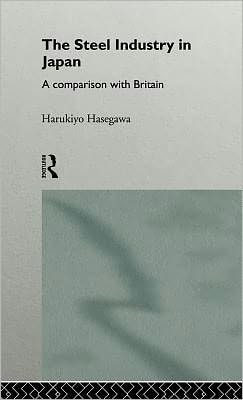
Steel Industry in Japan: A Comparison with Britain
0
0
As an Amazon Associate and affiliate partner, Menrva Books earns from qualifying purchases. Learn more
Author Description
The Japanese steel industry has experienced both boom and recession over the past 30 years and is now in real decline. Harukiyo Hasegawa analyzes the economic, technical and political changes paying particular attention to the impact of modern technology upon employees within the industry. Hasegawa introduces an important new conceptual tool for comparative study: "convergence". Challenging the simplistic notion of "leader" and "follower" industries, he utilizes this concept to investigate whether the steel industry, and by extension other manufacturing industries, can survive in mature economies.
Menrva's Summary
THE THESIS
This book investigates the economic, technical, and political factors that have shaped the Japanese steel industry and evaluates its long-term viability in comparison to the British steel industry. Harukiyo Hasegawa utilizes his expertise in industrial economics to examine the structural shifts within these two nations. By introducing the conceptual tool of 'convergence,' the author challenges traditional binary models of industrial development. The text provides a rigorous analysis of how technological integration affects labor dynamics and corporate survival in mature economic environments.
THE SCOPE MAP
What You Will Find
- Comparative analysis of Japanese and British steel manufacturing sectors over a thirty-year period.
- The 'convergence' framework for evaluating industrial development across different national contexts.
- Examination of the impact of modern automation and technological shifts on the industrial workforce.
- Case studies regarding the transition from growth cycles to periods of recession and decline.
THE AUTHORITY PERSPECTIVE
Scholars and industrial analysts frequently cite this work for its nuanced application of comparative economic theory to manufacturing history. The text is recognized as a significant contribution to the study of industrial decline and technological adaptation in developed economies.
Page Count:
368
Publication Date:
2003-01-01
Publisher:
Taylor & Francis Group
ISBN-10:
0203425545
ISBN-13:
9780203425541
Economics
History
Technology
United Kingdom
Japan
Manufacturing
Great Britain
Industry
Community Tags
Similar Books