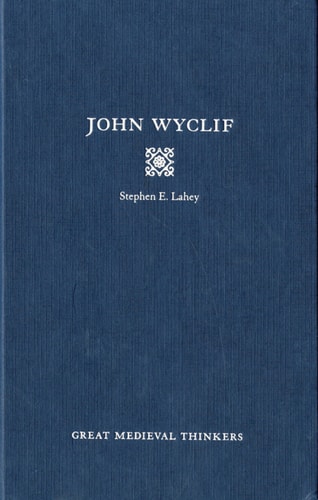
John Wyclif
0
0
As an Amazon Associate and affiliate partner, Menrva Books earns from qualifying purchases. Learn more
Author Description
John Wyclif (d.1384) has too frequently been described as "Morning Star of the Reformation" and only recently begun to be studied as a fourteenth-century English philosopher and theologian. This work draws on recent scholarship situating Wyclif in his fourteenth-century milieu to present a survey of his thought and writings as a coherent theological position arising from Oxford's "Golden Age" of theology. Lahey argues that many of Wyclif's best known critiques of the fourteenth-century Church arise from his philosophical commitment to an Augustinian realism evocative of the thought of Robert Grosseteste and Anselm of Canterbury. This realism is comprehensible in terms of Wyclif's sustained focus on semantics and the properties of terms and propositions, a "linguistic turn" characterizing post-Ockham philosophical theology. Arising from this propositional realism is a strong emphasis on the place of Scripture in both formal and applied theology, which was the starting point for many of Wyclif's quarrels with the ecclesiastical status quo in late fourteenth-century England. This survey takes into account both Wyclif's earlier, philosophical works and his later works, including sermons and Scripture commentary. Wyclif's belief that Scripture is the eternal and perfect divine word, the paradigm of human discourse and the definitive embodiment of truth in creation is central to an understanding of the ties he believes relate theoretical and practical philosophy to theology. This connection links Wyclif's interest in the propositional structure of reality to his realism, his hermeneutic program, and to his agenda for reform of the Church. Lahey's survey also highlights Wyclif's rejection of Bradwardine's determinism in favor of a model of human freedom in light of God's perfect foreknowledge, and also explores the relation of Wyclif's spatiotemporal atomism to his rejection of transubstantiation. This is the first book-length, comprehensive survey of Wyclif's thought, and
Menrva's Summary
THE THESIS
This work investigates how John Wyclif’s philosophical commitments to Augustinian realism and propositional logic informed his theological critiques of the fourteenth-century Church. Stephen Edmund Lahey, a scholar of medieval philosophy, utilizes recent academic research to recontextualize Wyclif not merely as a precursor to the Reformation, but as a product of the intellectual environment of Oxford’s Golden Age. The book argues that Wyclif’s radical ecclesiastical positions were the logical outcome of his specific linguistic and semantic theories.
THE SCOPE MAP
What You Will Find
- Analysis of Wyclif’s Augustinian realism and propositional logic.
- Examination of the relationship between Wyclif’s philosophy and his hermeneutic approach to Scripture.
- Discussion of Wyclif’s rejection of Bradwardine’s determinism and his views on human freedom.
- Exploration of Wyclif’s spatiotemporal atomism in the context of his rejection of transubstantiation.
Scope Limits
- The text focuses primarily on the intellectual and theological development of Wyclif rather than a comprehensive biographical account of his personal life.
- The analysis is limited to the context of fourteenth-century English scholasticism and may not address broader European political implications in detail.
THE AUTHORITY PERSPECTIVE
Experts recognize this work as a significant contribution to the study of medieval scholasticism, noting its success in moving beyond hagiographic interpretations of Wyclif. Readers frequently highlight the academic density of the prose, which assumes a foundational understanding of medieval philosophical terminology.
Page Count:
304
Publication Date:
2008-01-01
Publisher:
Oxford University Press
ISBN-10:
0190293055
ISBN-13:
9780190293055
Religion
Biography
Philosophy
History
Academic
European History
Theology
Religious History
Community Tags
Other Editions(2)
Similar Books


Reader Comments
Share Your Thoughts
No comments yet. Be the first to share your thoughts!