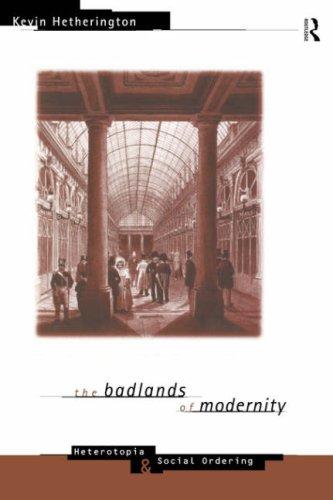
The Badlands of Modernity
0
0
As an Amazon Associate and affiliate partner, Menrva Books earns from qualifying purchases. Learn more
Author Description
The Badlands of Modernity offers a wide ranging and original interpretation of modernity as it emerged during the eighteenth century through an analysis of some of the most important social spaces. Drawing on Foucault's analysis of heterotopia, or spaces of alternate ordering, the book argues that modernity originates through an interplay between ideas of utopia and heterotopia and heterotopic spatial practice. The Palais Royal during the French Revolution, the masonic lodge and in its relationship to civil society and the public sphere and the early factories of the Industrial Revolution are all seen as heterotopia in which modern social ordering is developed. Rather than seeing modernity as being defined by a social order, the book argues that we need to take account of the processes and the ambiguous spaces in which they emerge, if we are to understand the character of modern societies. The book uses these historical examples to analyse contemporary questions about modernity and postmodernity, the character of social order and the significance of marginal space in relation to issues of order, transgression and resistance. It will be important reading for sociologists, geographers and social historians as well as anyone who has an interest in modern societies.
Menrva's Summary
THE THESIS
This book investigates how the emergence of modernity is fundamentally linked to the development of specific social spaces known as heterotopias. Kevin Hetherington, a scholar in social theory, utilizes the framework of Michel Foucault to examine how eighteenth-century spatial practices shaped modern social order. By analyzing the interplay between utopian ideals and heterotopic realities, the author argues that modernity is not a fixed state but a process defined by ambiguous, marginal spaces where social order is negotiated and contested.
THE SCOPE MAP
What You Will Find
- Historical analysis of the Palais Royal during the French Revolution, masonic lodges, and early Industrial Revolution factories.
- Application of Foucault’s concept of heterotopia to explain the origins of modern social ordering.
- Examination of the relationship between marginal spaces, transgression, and resistance in the formation of civil society.
- Theoretical synthesis connecting historical spatial practices to contemporary debates on modernity and postmodernity.
THE AUTHORITY PERSPECTIVE
Sociologists and social historians frequently cite this work as a significant contribution to the study of spatial theory and the social construction of modernity. Experts highlight the book's ability to bridge historical case studies with complex theoretical frameworks, making it a valuable resource for those studying the evolution of social spaces.
Page Count:
0
Publication Date:
1997-01-01
Publisher:
Routledge
ISBN-10:
0203428870
ISBN-13:
9780203428870
History
Modernity
Geography
Social Theory
Sociology