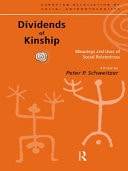
Dividends of Kinship: Meanings and Uses of Social Relatedness
0
0
As an Amazon Associate and affiliate partner, Menrva Books earns from qualifying purchases. Learn more
Author Description
This collection reaffirms the importance of kinship, and of studying kinship, within the framework of social anthropology. The contributors examine both the benefits and the burdens of kinship across cultures and explore how 'relatedness' is inextricably linked with other concepts which define people's identities, such as gender, power and history. With examples from a wide range of areas including Austria, Greenland, Portugal, Turkey and the Amazon, the book covers themes such as how people choose and activate kin; leadership, spiritual power and kinship; inheritance, marriage and social inequality; familial sentiment and economic interest; and the role of kinship in Utopian communes. It will be of interest to undergraduates, postgraduates and academics in anthropology, and across the social sciences.
Menrva's Summary
THE THESIS
This collection investigates the enduring significance of kinship as a primary framework for understanding social relatedness and human identity across diverse cultural contexts. Editor Peter P. Schweitzer compiles research from various anthropologists to analyze how kinship functions as both a supportive structure and a source of social burden. The text argues that relatedness remains inextricably linked to broader societal concepts, including power dynamics, gender roles, and historical development, challenging the notion that kinship is a static or declining institution.
THE SCOPE MAP
What You Will Find
- Cross-cultural case studies from regions including Austria, Greenland, Portugal, Turkey, and the Amazon.
- Analysis of the intersection between familial sentiment and economic interest.
- Examination of kinship roles within specific social structures like Utopian communes.
- Theoretical frameworks regarding inheritance, marriage, and the maintenance of social inequality.
THE AUTHORITY PERSPECTIVE
Experts identify this collection as a valuable resource for students and academics seeking to understand the contemporary relevance of kinship studies. Readers frequently note the academic density of the prose, which serves as a foundational text for those exploring the complexities of social relatedness in modern anthropology.
Page Count:
232
Publication Date:
2003-01-01
Publisher:
Taylor & Francis Group
ISBN-10:
0203449754
ISBN-13:
9780203449752
Sociology
Social Science
Anthropology
Community Tags
Similar Books