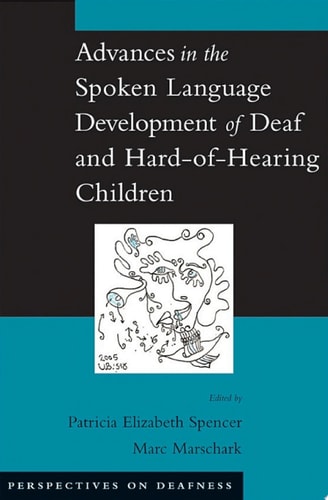
Advances in the Spoken-Language Development of Deaf and Hard-of-Hearing Children
0
0
As an Amazon Associate and affiliate partner, Menrva Books earns from qualifying purchases. Learn more
Author Description
Throughout history there have been efforts to help deaf children develop spoken language through which they could have full access to the hearing world. These efforts, although pursued seriously and with great care, frequently proved fruitless, and often only resulted in passionate arguments over the efficacy of particular approaches. Although some deaf children did develop spoken language, there was little evidence to suggest that this development had been facilitated by any particular education approach, and moreover, many, even most deaf children--especially those with profound loss--never develop spoken language at all. Recent technological advances, however, have led to more positive expectations for deaf children's acquisition of spoken language: Innovative testing procedures for hearing allow for early identification of loss that leads to intervention services during the first weeks and months of life. Programmable hearing aids allow more children to make use of residual hearing abilities. Children with the most profound losses are able to reap greater benefits from cochlear-implant technologies. At the same time, there have been great advances in research into the processes of deaf children's language development and the outcomes they experience. As a result, we are, for the first time, accruing a sufficient base of evidence and information to allow reliable predictions about children's progress that will, in turn, lead to further advances. The contributors to this volume are recognized leaders in this research, and here they present the latest information on both the new world evolving for deaf and hard-of-hearing children and the improved expectations for their acquisition of spoken language. Chapters cover topics such as the significance of early vocalizations, the uses and potential of technological advances, and the cognitive processes related to spoken language. The contributors provide objective information from children in a variety of programming.
Menrva's Summary
THE THESIS
This volume investigates the efficacy of modern technological and pedagogical interventions in facilitating spoken-language acquisition among deaf and hard-of-hearing children. Editors Marc Marschark and Patricia Elizabeth Spencer, both established scholars in the field of deafness and education, synthesize current research to move beyond historical debates. They argue that early identification and advanced assistive technologies have created a new empirical foundation for understanding language development outcomes in this population.
THE SCOPE MAP
What You Will Find
- Analysis of early vocalization patterns in infants with hearing loss
- Evaluation of cochlear implant and programmable hearing aid integration
- Cognitive process modeling related to language acquisition
- Comparative data across various educational programming models
Scope Limits
- Does not provide a comprehensive guide for clinical surgical procedures
- Does not focus on sign language acquisition or bilingual educational frameworks
THE AUTHORITY PERSPECTIVE
Experts in the field of special education and audiology recognize this text as a significant compilation of research regarding the impact of modern technology on language outcomes. Readers frequently note the academic density of the prose, which is intended primarily for researchers, clinicians, and graduate-level students.
Page Count:
399
Publication Date:
2005-01-01
Publisher:
Oxford University Press
ISBN-10:
0190292652
ISBN-13:
9780190292652
Psychology
Introduction to Human Communication
Deaf education
Education
Professional Career & Trade
Developmental Psychology
Sign language
Special Education
Audiology
English
Communications
English & College Success
Linguistics
Community Tags
Other Editions(4)



Similar Books








Reader Comments
Share Your Thoughts
No comments yet. Be the first to share your thoughts!