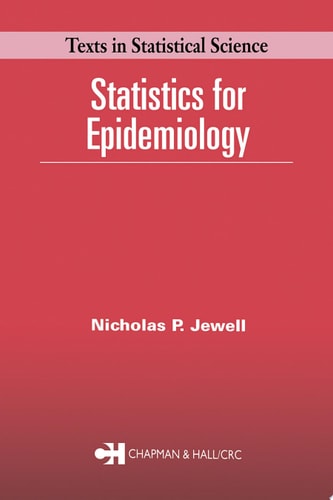
Statistics for Epidemiology
0
0
As an Amazon Associate and affiliate partner, Menrva Books earns from qualifying purchases. Learn more
Author Description
Statistical ideas have been integral to the development of epidemiology and continue to provide the tools needed to interpret epidemiological studies. Although epidemiologists do not need a highly mathematical background in statistical theory to conduct and interpret such studies, they do need more than an encyclopedia of "recipes." Statistics for Epidemiology achieves just the right balance between the two approaches, building an intuitive understanding of the methods most important to practitioners and the skills to use them effectively. It develops the techniques for analyzing simple risk factors and disease data, with step-by-step extensions that include the use of binary regression. It covers the logistic regression model in detail and contrasts it with the Cox model for time-to-incidence data. The author uses a few simple case studies to guide readers from elementary analyses to more complex regression modeling. Following these examples through several chapters makes it easy to compare the interpretations that emerge from varying approaches. Written by one of the top biostatisticians in the field, Statistics for Epidemiology stands apart in its focus on interpretation and in the depth of understanding it provides. It lays the groundwork that all public health professionals, epidemiologists, and biostatisticians need to successfully design, conduct, and analyze epidemiological studies.
Menrva's Summary
THE THESIS
This book investigates how to bridge the gap between abstract statistical theory and the practical application of data analysis in epidemiological research. Nicholas P. Jewell, a prominent biostatistician, provides a framework that moves beyond rote memorization of formulas to foster an intuitive grasp of statistical methods. By focusing on the interpretation of results rather than purely mathematical derivation, the text equips public health professionals with the necessary skills to design and evaluate studies effectively.
THE SCOPE MAP
What You Will Find
- Techniques for analyzing simple risk factors and disease data.
- Detailed coverage of the logistic regression model and its application.
- Comparative analysis between logistic regression and the Cox model for time-to-incidence data.
- Step-by-step case studies that guide readers from elementary analysis to complex regression modeling.
THE AUTHORITY PERSPECTIVE
Experts and practitioners recognize this text as a foundational resource for those seeking to understand the mechanics of epidemiological data without becoming overwhelmed by theoretical density. Readers frequently note that the author's consistent use of case studies across chapters provides a clear, logical progression that aids in mastering complex statistical interpretations.
Page Count:
352
Publication Date:
2003-08-26
Publisher:
Chapman & Hall/CRC
ISBN-10:
0203496868
ISBN-13:
9780203496862
Science
Medicine
Public Health
Statistics
Biostatistics
Applied
Epidemiology
Mathematics
Community Tags
Similar Books