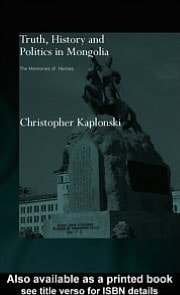
Truth, History and Politics in Mongolia: Memory of Heroes
0
0
As an Amazon Associate and affiliate partner, Menrva Books earns from qualifying purchases. Learn more
Author Description
Using Mongolia as its example, this book examines how knowledge is transmitted and transformed in light of political change by looking at shifting conceptions of historical figures. It suggests that the reflection of people's concept of themselves is a much greater influence in the writing of history than has previously been thought and examines in detail how history was used to subvert the socialist project in Mongolia. This is the first study of the symbolic struggle over who controlled 'the past' and the 'true' identity of a Mongol, fought between the ruling party and its protesters during the democratic revolution.
Menrva's Summary
THE THESIS
This book investigates how historical narratives and the memory of national figures are manipulated to serve shifting political agendas during periods of systemic transition. Christopher Kaplonski, an anthropologist specializing in Mongolian studies, utilizes ethnographic data and historical analysis to argue that the construction of history is fundamentally tied to the collective identity of a populace. He demonstrates how the struggle to define the 'true' Mongol identity became a primary site of resistance against the socialist state during the democratic revolution.
THE SCOPE MAP
What You Will Find
- Analysis of the symbolic struggle over historical memory in post-socialist Mongolia.
- Examination of how political actors utilize historical figures to legitimize or subvert state power.
- Qualitative evidence derived from interviews and archival research regarding the democratic revolution.
- A theoretical framework for understanding the transmission of knowledge during political upheaval.
THE AUTHORITY PERSPECTIVE
Scholars in the field of Central Asian studies recognize this work as a foundational text for understanding the intersection of memory, identity, and political legitimacy. Readers frequently note the academic density of the prose, which provides a rigorous examination of the mechanisms behind historical revisionism.
Page Count:
248
Publication Date:
2004-02-01
Publisher:
Routledge
ISBN-10:
0203491734
ISBN-13:
9780203491737
Politics
History
Anthropology
Asia
Schools & Teaching
Russia
Sociology
Instruction Methods
Central Asia