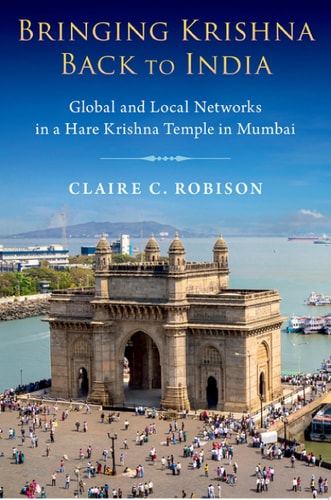
Bringing Krishna Back to India: Global and Local Networks in a Hare Krishna Temple in Mumbai
0
0
As an Amazon Associate and affiliate partner, Menrva Books earns from qualifying purchases. Learn more
Author Description
The Hare Krishnas have long been associated with Western hippie culture and New Age religious movements, but they have also developed deeply rooted communities in India and throughout the world over the past 50 years. Known officially as the International Society for Krishna Consciousness (ISKCON), this once-marginal religious community now wields vast economic assets, political influence, and a posh identity endorsed by Indian business tycoons and Bollywood celebrities.Bringing Krishna Back to India examines the place of this globalized religious community in Mumbai, India's business and entertainment capital, where ISKCON draws Indians from diverse regional and religious backgrounds and devotees adopt a conservative religious identity amidst a neoliberal urban context. Claire C. Robison examines the full-circle globalization of this religious movement and considers how religious revivalism shifts people's relationships to their religion, family, culture, and nation. By inhabiting a Hindu revivalist role, ISKCON educates Hindus and Jains into a new vision of their own traditions and promotes greater religiosity in Indian public life. This contradicts notions that societies are moving towards secularism and highlights how new religious identities are fashioned amidst industrialized urban spaces, such as college campuses, corporate wellness retreats, and Bollywood celebrity events. It also shows how local religion is shaped by transnational networks-even forms of revivalism that revere premodern ideals. In urban India religious traditionalism is often a form of cosmopolitanism, partaking in neoliberal economies, shaping political trends, and reflecting elite urban aspirations and aesthetics.
Menrva's Summary
THE THESIS
This book investigates how the International Society for Krishna Consciousness (ISKCON) has transformed from a Western-associated movement into a powerful, elite-endorsed religious institution within the neoliberal urban landscape of Mumbai. Claire C. Robison, an expert in religious studies and anthropology, utilizes ethnographic fieldwork and sociological analysis to argue that ISKCON’s success in India is not a rejection of modernity, but rather a sophisticated form of cosmopolitanism. She demonstrates how the movement leverages transnational networks and corporate-style aesthetics to reshape Hindu identity and public life in contemporary India.
THE SCOPE MAP
What You Will Find
- Analysis of ISKCON’s integration into Mumbai’s corporate, entertainment, and academic sectors.
- Examination of the intersection between neoliberal economic structures and religious revivalism.
- Qualitative data derived from ethnographic observations of temple life and devotee interactions.
- Exploration of how global religious movements adapt to local cultural and political contexts.
THE AUTHORITY PERSPECTIVE
Scholars of South Asian religion and globalization recognize this work as a significant contribution to understanding the evolution of modern Hindu movements. Readers frequently note the clarity with which the author connects abstract sociological theories to the specific, lived realities of urban Indian devotees.
Page Count:
336
Publication Date:
2024-01-01
Publisher:
Oxford University Press
ISBN-10:
0197656455
ISBN-13:
9780197656457
History
Philosophy
Religion
Politics
Schools & Teaching
Sociology
India
Anthropology
Globalization
Jainism
Hinduism
Asia
Sacred texts
Community Tags
Similar Books














