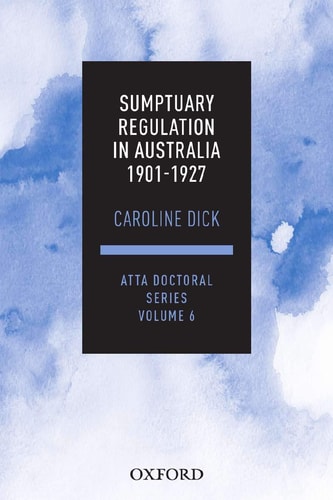
Sumptuary Regulation in Australia 1901-1927
0
0
As an Amazon Associate and affiliate partner, Menrva Books earns from qualifying purchases. Learn more
Author Description
Unpicking the laws of consumption in early 20th century AustraliaIt is generally considered that sumptuary law is an archaic form of governmental intervention that targeted the personal lives of people living in the early modern period in Europe, and has no modern significance. This book examines the post Federation period, between 1901 and 1927, to reveal that the sumptuary impulse was not only alive and well in the emergent modern Australia, but was transmuted by a new patrician elite into a form of social and legal regulation.Sumptuary Regulation in Australia 1901-1927 contends that this regulation was enacted primarily to control the clothing and entertainment choices of working Australians. The impulse was sustained through taxation and fiscal legal mechanisms (tariffs, for instance), wage cases, and through the agency of wartime regulations. All of these measures recall the sumptuary laws of early modern Europe.Iumptuary Regulation in Australia 1901-1927 is the sixth volume in the Australasian Tax Teachers' Association (ATTA) Doctoral Series.
Menrva's Summary
THE THESIS
This book investigates whether the sumptuary impulse, traditionally associated with early modern Europe, persisted as a form of social and legal regulation in post-Federation Australia between 1901 and 1927. Caroline Dick, drawing upon her doctoral research, challenges the assumption that sumptuary law is an archaic relic. She argues that a new patrician elite in early 20th-century Australia utilized fiscal mechanisms, wage arbitration, and wartime regulations to exert control over the consumption, clothing, and entertainment habits of the working class.
THE SCOPE MAP
What You Will Find
- Analysis of post-Federation Australian social and legal history from 1901 to 1927.
- Examination of fiscal tools including tariffs and taxation as instruments of social control.
- Investigation into the role of wage cases and wartime regulations in shaping personal consumption.
- A comparative framework linking modern Australian regulatory practices to early modern European sumptuary traditions.
Scope Limits
- The study is strictly confined to the period between 1901 and 1927.
- The analysis focuses primarily on the intersection of law and consumption rather than broader cultural history.
THE AUTHORITY PERSPECTIVE
Experts recognize this work as a specialized contribution to the Australasian Tax Teachers' Association Doctoral Series, providing a unique intersectional view of legal and social history. Readers frequently note the academic density of the prose, which is tailored for scholars interested in the evolution of regulatory mechanisms in the Australian context.
Page Count:
260
Publication Date:
2018-07-17
Publisher:
Oxford University Press
ISBN-10:
0190312769
ISBN-13:
9780190312763
History
Taxation Law
Sumptuary Laws
Sociology
Australian History
Legal History
Law australia
Community Tags
Similar Books