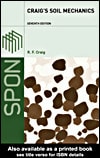
Craig's Soil Mechanics
0
0
As an Amazon Associate and affiliate partner, Menrva Books earns from qualifying purchases. Learn more
Author Description
This is the seventh edition of the best selling text Soil Mechanics, widely praised for its clarity, depth of explanation and extensive coverage. As with previous editions, it presents the fundamental principles of soil mechanics and illustrates how they are applied in practical situations. Worked examples throughout the book reinforce the explanations and a range of problems for the reader to solve provides further learning opportunities.Craig's Soil Mechanics assembles all the essential elements of an undergraduate course, leading from the properties of soils and basic theory through to practical applications such as retaining structures and foundations. Both the traditional and limit state methods of design are included, some of the concepts of geotechnical engineering are introduced and the different types of field instrumentation are described. Case studies provide the essential features of ten geotechnical projects and the differences between prediction and performance are illustrated and discussed.
Menrva's Summary
THE THESIS
This text investigates the fundamental principles of soil mechanics and their application to practical geotechnical engineering challenges. R. F. Craig provides a comprehensive framework for undergraduate students, bridging the gap between theoretical soil properties and real-world structural design. The book utilizes a structured pedagogical approach, incorporating both traditional and limit state design methods to ensure a thorough understanding of the field.
THE SCOPE MAP
What You Will Find
- Comprehensive coverage of soil properties and basic theoretical mechanics.
- Practical applications including the design of retaining structures and foundations.
- Worked examples and problem sets designed to reinforce technical comprehension.
- Case studies of ten geotechnical projects comparing predictive models to actual performance.
THE AUTHORITY PERSPECTIVE
Experts and educators frequently cite this work as a foundational text for undergraduate civil engineering curricula. Readers often note the clarity of the explanations and the utility of the included case studies in bridging theoretical concepts with field instrumentation.
Page Count:
464
Publication Date:
2004-01-01
Publisher:
Taylor & Francis Group Plc
ISBN-10:
0203574419
ISBN-13:
9780203574416
Science
textbook
Engineering
Soil Mechanics
Technology
Nonfiction
Geotechnical Engineering
Civil Engineering
Community Tags
Other Editions(2)

Similar Books