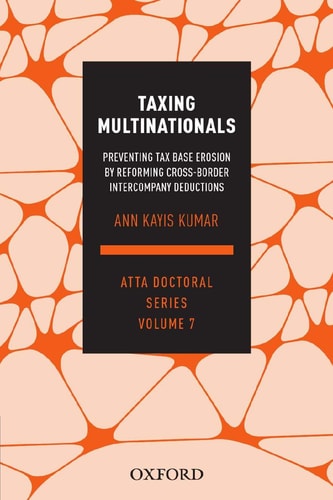
Taxing Multinationals: Preventing Tax Base Erosion Through the Reform of Cross-Border Intercompany Deductions
0
0
As an Amazon Associate and affiliate partner, Menrva Books earns from qualifying purchases. Learn more
Author Description
One of the most significant trends in the evolution of global tax systems has been the rise from relative obscurity of thin capitalisation rules, which are perceived as anti-avoidance rules. Despite their prevalence, it is unclear whether thin capitalisation rules: (1) attain tax neutrality (specifically, do these rules mitigate the tax-induced cross-border debt bias); and, (2) are effective in both theory and practice.Taxing Multinationals approaches the issue of thin capitalisation from a novel perspective by conceptualising the cross-border debt bias as the 'disease' and thin capitalisation as merely the 'symptom'. The overarching question guiding this book is whether, given the opportunity to start over, the tax-induced cross-border debt bias would be better addressed by retaining thin capitalisation rules in their current form or whether an alternative reform would be more suited to dealing with this 'disease'.Taxing Multinationals: Preventing tax base erosion through the reform of cross-border intercompany deduction is the seventh volume in the Australasian Tax Teachers' Association (ATTA) Doctoral Series.
Menrva's Summary
THE THESIS
This book investigates whether thin capitalization rules effectively mitigate tax-induced cross-border debt bias or if alternative reforms are required to address the underlying erosion of tax bases. Ann Kayis-Kumar, an expert in taxation, utilizes a comparative and analytical framework to evaluate the efficacy of current anti-avoidance measures. The author argues that existing rules often treat symptoms rather than the root cause of debt bias, proposing a re-evaluation of how multinational corporations manage intercompany deductions.
THE SCOPE MAP
What You Will Find
- Analysis of thin capitalization rules as anti-avoidance mechanisms
- Evaluation of tax neutrality in cross-border transactions
- Theoretical and practical assessment of intercompany deduction reforms
Scope Limits
- Does not provide a comprehensive guide to individual country tax codes
- Focuses primarily on the structural debt bias rather than broader corporate tax evasion strategies
THE AUTHORITY PERSPECTIVE
Experts recognize this work as a significant contribution to the ATTA Doctoral Series, providing a rigorous academic examination of international tax policy. Readers frequently note the technical density of the prose, making it a specialized resource for tax practitioners and scholars interested in base erosion and profit shifting.
Page Count:
260
Publication Date:
2020-09-18
Publisher:
Oxford University Press
ISBN-10:
0190319313
ISBN-13:
9780190319311
International business
Academic
Business Law
Tax Law
Corporate Finance
Community Tags
Similar Books