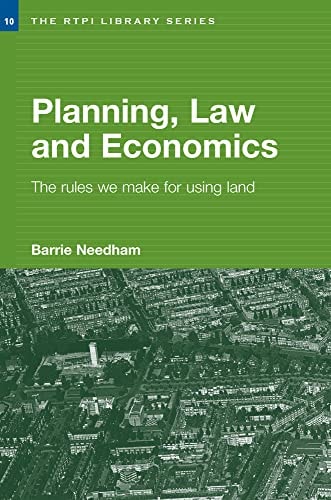
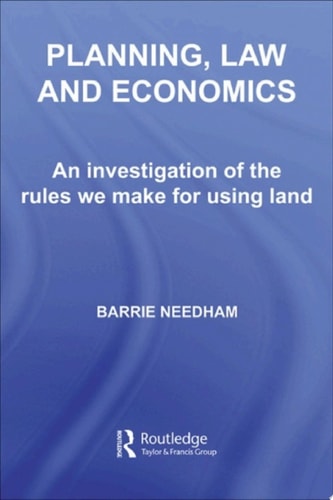
Planning, Law and Economics
0
0
As an Amazon Associate and affiliate partner, Menrva Books earns from qualifying purchases. Learn more
Author Description
What rights does the state have over privately owned land? Why should some landowners be favoured over others? How can the practice of land-use planning be improved?This book addresses these essential questions and shows that the interests people have in property rights over land and buildings are not just emotional but often financial too. It follows that the law, which affects who has property rights, what those rights are and how they may be used, can have great financial consequences for people and great economic consequences for society in general.For those reasons, looking at land-use planning as it affects and is affected by property rights illuminates some core aspects of land-use planning, including the law, economics, ethics and ideology. In this book, Needham examines those aspects from the clear perspective of property rights.
Menrva's Summary
THE THESIS
This book investigates the intersection of land-use planning, property rights, and economic outcomes to determine how state intervention impacts private land ownership. Barrie Needham, an expert in spatial planning, utilizes a property-rights framework to analyze the complex relationship between legal regulations and financial consequences. By examining the ethical and ideological underpinnings of planning, the author argues that understanding property rights is essential for improving the practice and efficiency of land-use management.
THE SCOPE MAP
What You Will Find
- Analysis of the legal mechanisms governing private land ownership and state intervention.
- Economic evaluation of how planning decisions influence property values and societal wealth.
- Ethical and ideological frameworks for assessing land-use policy.
- Practical strategies for improving the effectiveness of planning systems.
THE AUTHORITY PERSPECTIVE
Experts recognize this work as a foundational text for understanding the economic dimensions of planning law. Readers frequently note the clarity of the author's property-rights perspective, which provides a structured approach to complex regulatory issues.
Page Count:
208
Publication Date:
2005-10-31
Publisher:
Taylor & Francis Group
ISBN-10:
0203639650
ISBN-13:
9780203639658
Economics
Law And Legislation
Land Use
Law
Public Policy
urban planning
Community Tags
Other Editions(3)

Similar Books