Legal Foundations of Land Use Planning: Textbook-Casebook and Materials on Planning Law
0
0
As an Amazon Associate and affiliate partner, Menrva Books earns from qualifying purchases. Learn more
Author Description
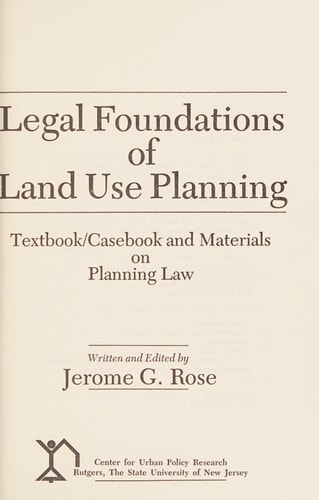
Urban planning is a community process, the purpose of which is to develop and implement a plan for achieving community goals and objectives. In this process, planners employ a variety of disciplines, including law. However, the law is only an instrument of urban planning, and cannot solve all urban problems or meet all social needs. The ability of the legal system to implement the planning process is limited by philosophical, historical, and constitutional constraints. Jurisprudence is concerned with societal values and relationships that limit the effectiveness of the law as an instrument of urban planning. When law is definite and certain, freedom is enhanced within the boundaries created by the law. This doctrine of Anglo-American law imposes an obligation on courts to be guided by prior judicial decision or precedents and, when deciding similar matters, to follow the previously established rule unless the case is distinguishable due to facts or changed social, political, or economic conditions The author focuses on seven specific areas of law in relation to land use planning: law as an instrument of planning, zoning, exclusionary zoning and managed growth, subdivision regulations, site plan review and planned unit development, eminent domain, and the transfer of development rights. Jerome G. Rose cites more than one hundred court cases, and the indexed list serves as a useful encyclopedia of land use law. This is a valuable sourcebook for all legal experts, urban planners, and government officials.
Menrva's Summary
THE THESIS
This text investigates the intersection of the legal system and urban planning, specifically examining how constitutional, historical, and philosophical constraints limit the law's effectiveness as a tool for community development. Jerome G. Rose, an expert in land use law, provides a comprehensive framework that balances theoretical jurisprudence with the practical application of legal precedents. By analyzing the role of courts in interpreting land use regulations, the author argues that law functions as a structured instrument that must adapt to changing social and economic conditions while maintaining the stability of established rules.
THE SCOPE MAP
What You Will Find
- Analysis of seven core legal areas including zoning, subdivision regulations, and eminent domain.
- A collection of over one hundred court cases serving as a legal encyclopedia.
- Examination of exclusionary zoning and managed growth strategies.
- Discussion of the transfer of development rights and site plan review processes.
THE AUTHORITY PERSPECTIVE
Legal experts and urban planners frequently cite this work as a foundational reference for understanding the regulatory environment of land development. The text is noted for its academic density and its utility as a primary sourcebook for government officials and practitioners in the field.
Page Count:
561
Publication Date:
2017-01-01
Publisher:
Taylor & Francis Group
ISBN-10:
0203787358
ISBN-13:
9780203787359
textbook
Law
Land Use
Law And Legislation
Government
City Planning
Public Policy
urban planning